
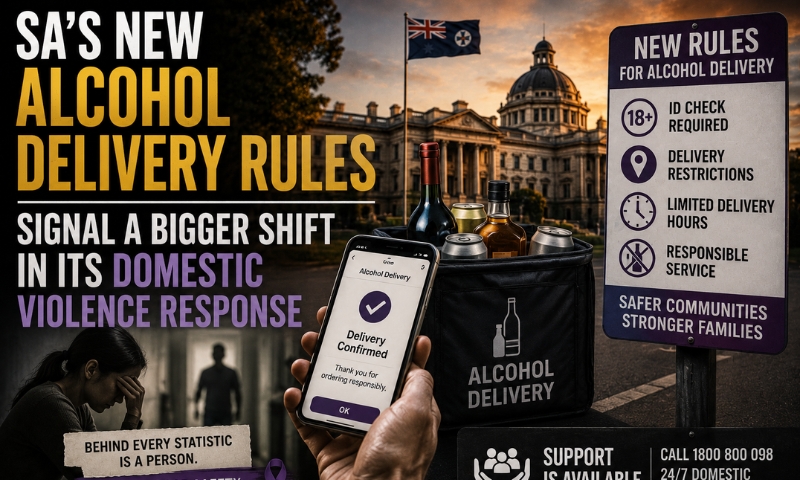
SA government (South Australia) is about to make it noticeably harder to get alcohol delivered on a whim, and the reasoning behind the change has little to do with retail logistics and everything to do with keeping people safe at home. New legislation heading to parliament this week will introduce a mandatory two-hour gap between placing a home delivery of alcohol online, alongside tighter delivery windows – measures drawn directly from the findings of a landmark inquiry into family violence.
For a state that has spent the past year working through the fallout of that inquiry, the reforms mark one of the most tangible policy shifts to emerge from it so far.
Why the Royal Commission Put Alcohol under the Microscope
The push for reform traces back to the Royal Commission into Domestic, Family and Sexual Violence, which spent months examining the drivers behind abuse across South Australia. Among its 136 recommendations, several focused specifically on how easily accessible alcohol has become – and how that accessibility can intensify already dangerous situations. The royal commission’s findings pointed to a growing body of evidence linking rapid alcohol delivery to escalations in violence, prompting calls for the kind of “safety pause” now being written into law.
Premier Peter Malinauskas confirmed the government would restrict same-day alcohol deliveries to a window between 10am and 10pm, with a compulsory two-hour delay between purchase and drop-off. “People will still be able to purchase alcohol online and have it delivered to their home, but there has to be a two-hour delay between the purchase being initiated and the order being completed,” he said, describing the restriction on delivery hours as simply making sense given the harm the reforms are designed to prevent.
The SA Government’s Broader Five-Year Commitment
Beyond the alcohol reforms, the SA government has now formally committed to a five-year implementation plan named Building Safer Futures, designed to systematically work through the royal commission’s full suite of recommendations. Officials describe the plan as an early blueprint covering 63 recommendations accepted in full, 19 accepted in part, and six noted for further consideration.
The SA government says a response has already been undertaken to 12 of the recommendations and is currently underway for another 25, as part of the early rollout of Building Safer Futures. The rate is prompting a sense of guarded optimism among advocacy groups, who had been frustrated at the slow pace at which reforms are being implemented since the initial report.
Home Delivery of Alcohol Rules Draw Mixed Reaction
Not everyone is applauding the change. Retail Drinks Australia, representing the packaged liquor industry, argued the SA government hadn’t demonstrated how forcing a delay on home delivery of alcohol would meaningfully reduce harm. Chief executive Michael Waters said the case for the new restriction remained unproven from an evidentiary standpoint.
Brown separately confirmed the government intended to satisfy a related royal commission recommendation by changing the long title of the Liquor Licensing Act, formally embedding harm minimization as its paramount consideration. Further detail on how that change will be applied, he said, would be revealed in time.
Political Support and What Comes Next
The legislation appears likely to clear the upper house, where the SA government needs two additional votes to secure passage. Greens MLC Robert Simms confirmed his party’s support, calling the reform to regulate home delivery “long overdue” and pledging cooperation to see the bill move quickly through parliament.
Malinauskas acknowledged the timeline had shifted from his original commitment to introduce the legislation immediately following the March election, attributing the delay to a review by the new Consumer and Business Affairs Minister, Michael Brown. “There’s not any specific reason for the delay rather than making sure that we try and get it right,” the premier said, noting the Consumer and Business Services department would need expanded capacity to properly enforce the new rules once passed.
Taken together, the alcohol reforms and the Building Safer Futures roadmap represent the most concrete signal yet that the SA government intends to treat the royal commission’s findings as a genuine framework for action rather than a report destined to gather dust – even as questions remain about how quickly the remaining recommendations will be delivered. For families and frontline services who lived through the inquiry’s public hearings, that distinction between a promise on paper and a change felt in daily life is likely to matter more than any single legislative milestone.