
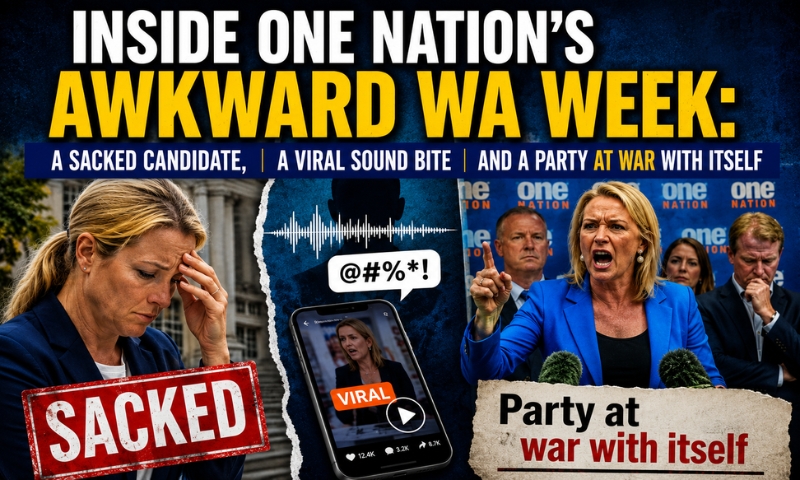
The Comments That Started It All
The story began when Parminder Singh, who had run third on One Nation’s upper house ticket in WA at the 2025 election, was revealed to have made a string of homophobic remarks in a video shared on social media. Singh suggested that gay individuals were suffering from mental illness, and he said that animals were smarter than man due to their lack of gayness.
The comment didn’t come out of nowhere. It arrived in the middle of a genuine mess for One Nation, one that started with a failed WA candidate and ended with the party’s newest recruit fumbling his way into one of the more memorable political grabs of the year.
One nation’s reaction was swift, Singh’s profile of the candidate was taken down from the party’s website within half an hour of reporters reaching out to Pauline Hanson’s office. Though the reaction was quick but many would say it is not enough. Though One Nation has scrubbed the webpage and Singh has failed in election as well, doesn’t necessarily mean that he is completely out of the picture. If another MP is disqualified or resigns he may still be able to the vacancy.
Barnaby Joyce’s Unexpected Response
Enter Barnaby Joyce, who fronted ABC’s Afternoon Briefing the same day the story broke and delivered the line that’s since taken on a life of its own. Asked about Singh’s comments, Joyce didn’t just distance himself, he went further, declaring the party had “quite a large proportion of gay people” and insisting, somewhat reluctantly, that One Nation might be “one of the gayest parties in Australia.”
His answer was like a curveball when the presenter Patricia Karvels asked him what he meant by “Singh obviously hasn’t been around farms”. Joyce confirmed that he was referring the fact about gay animals. He laughed it off when Patricia candidly asked him, that if he was trying to come out to her on live television. He was given a nickname of “Brokeback Barnaby”, shortly after the interview by coalition colleagues in a nod to 2005 film Brokeback Mountain.
Pauline Hanson’s Complicated History on the Issue
Pauline Hanson later chimed in, slamming Singh’s remarks and saying that they did not represent her views. However, as soon as the news was released, critics took to social media to remind people that the Hanson connection with LGBTQ matters was never easy. Back in 1996, she said in an interview that personally, she did not like the Sydney Gay and Lesbian Mardi Gras, which was trying to put on “something no natural.” She did agree that a person’s sexuality was a matter for them alone.
Recently when asked about those old comments, Hanson did not come back on that. But she still doesn’t like the festival, based on her personal opinion and not party policy, and admits it welcomes tourism dollars into the country.
A Party Pulling in Two Directions
What makes this story more interesting than a single bad sound bite out of WA is what it reveals about where One Nation actually sits on gay rights nationally, which turns out to be nowhere consistent at all. In South Australia, Cory Bernardi, a former Liberal senator who now leads the state branch, has stood by remarks he made years ago in the federal Senate linking same-sex marriage to polygamy and bestiality, saying recently he’s “not fussed” if people find those comments offensive.
Yet in that very same SA election, the party elected an openly gay MP, Jason Virgo, who broke down in tears in parliament describing his 11-year relationship with his boyfriend, a Muslim migrant from Indonesia. Virgo spoke warmly about the immigrant friendships that
Why the Politics Have Actually Shifted
For all the theatre, Joyce may be onto something real. Marriage equality has been law in Australia for more than eight years now, and the predicted catastrophes never materialized. The debate over same-sex marriage feels almost quaint compared to today’s flashpoints around gender and trans rights, which have become the new front line of the culture wars.
That doesn’t mean homophobia has vanished from Australian politics, but openly attacking gay and lesbian voters now carries a political cost that simply didn’t exist when Hanson first entered parliament decades ago. There’s no single unified “gay vote,” any more than there’s a single straight one. But next year’s census results will give political strategists something they’ve never really had: a clearer national picture of where LGBTQI Australians actually live, electorate by electorate.