
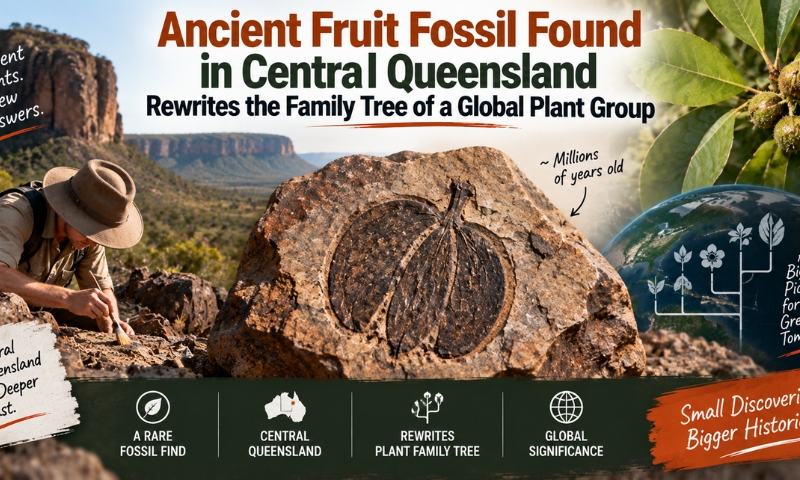
A strange fruit fossil was found near a small farming town called Capella Queensland, and it doesn’t matched with any current genus or species of plants.
Queensland Museum principal geoscience scientist Andrew Rozefelds said it was an unusual find, as it was when we first discovered it it looked a bit like lizard skin. I thought, ‘It can’t be, ‘ cause typically you don’t get vertebrates when you get plants. We were faced with a plant we’ve never seen before
That confusion turned out to be the beginning of a genuine breakthrough. The specimen has since been identified as a fossil of the Melastomataceae family — and not just any find, but the very first confirmed record of that plant group anywhere in Australia or across eastern Gondwana, the ancient supercontinent that once linked much of the southern hemisphere.
A New Species Emerges From Central Queensland Rock
This 30 million years old fossil has created and entirely new genus and species called Capella raulingsi after a nearby town named Capella.
Melastomataceae today are a familiar sight throughout the tropics, with several species scattered across the country’s north and east. But finding fossil evidence of the family this far south, and this old, had never happened before. Dr Rozefelds and colleagues published their findings this month in the International Journal of Plant Sciences, alongside a challenge to a long-held theory about how the plant family first arrived.
Dr Rozefeld stated that most recent molecular data suggested that this family of plants migrated into Australia from South-East Asia.
Rewriting the Melastomataceae Migration Story
Instead, the fossil suggests Melastomataceae plants were already established here roughly 30 million years ago — long before the continent drifted close enough to South-East Asia for plants to island-hop across. That timing points to a Gondwanan origin rather than a later Asian one.
These fossils indicate that the first members of the Melastomataceae were present in Australia many millions of years before any contact has been made with South-East Asia.
This discovery is a real proof of the presence of such plants in Gondwana rainforest. Also, this will lead to a review of the biogeography of all the plants of this family.
The part of the supercontinent that produced the future Australian continent began to break up about 180 million years ago and eventually gave rise to the continents as they are now.The area of the supercontinent that produced the future Australian landmass started to split about 180 million years ago, resulting in the present-day continents of South America, Africa, Madagascar, India and Antarctica. The fossil records provides a rare tangible fixation point in the otherwise ambiguous history of a living plant family when it finds direct fossil evidence linking it to that breakup.
Volcanic Rock Preserved a Rainforest Snapshot
The fossils were found in an exceptionally hard type of rock, known as silcrete, on farmland near Capella, said University of Queensland researcher Anita Milroy, a co-author of the study. About 30 million years ago this was a very different place, she said.
Techniques like high intentsity X- ray, syncotron imaging etc were used to examine the plant without damaging it.
“Now it’s a technique that’s used right across the board in palaeobotany,” Dr Milroy said. “We can actually see inside these fruits, we don’t have to destroy them.”
Why Soft-Tissue Fossils Are So Rare
The research also documents the first known whole fruit specimen of any Melastomataceae species found anywhere in the world, since most examples that survive are flattened or fragmentary.
Vera Korasidis (from University of Melbourne palaeontologist), wasn’t involved in this search and study, said it was exceptional. Because finding a plant fossil is a rare occasion.
According to Dr Korisidis bones and teeth are easy to fossilize due to their hard structure but plants can deform easily due to their soft tissues. Hence there is a need for more digging around the area.
For a single fruit pulled from a paddock near Capella, that’s a considerable legacy — quietly rewriting the migration story of a plant family found across the globe.