
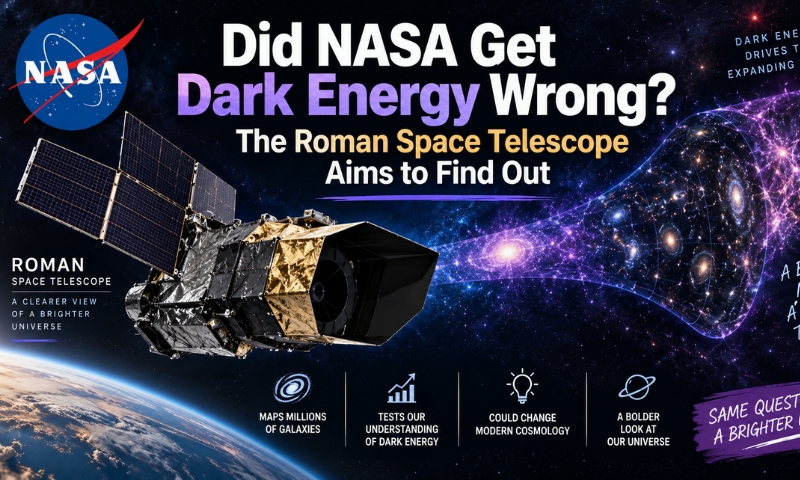
The Hubble space telescope made some unique discoveries 30 years ago, which were mind boggling for scientists. They knew that the universe was expanding, but after this they came to know that the expansion was also speeding up. The Roman Space telescope has achieved a new breakthrough after more than 30 years. Scientists blamed an invisible force they called dark energy, and the discovery eventually earned a Nobel prize for a trio of astrophysicists, including Australian-born Brian Schmidt. Hubble itself lifted off from Kennedy Space Center in Florida back in 1990, decades before this mission’s own turn came.
Now a new observatory has left Earth with a similar mission: work out whether that force has been correctly understood all along, or whether the model needs a rewrite.
The Nancy Grace Roman Space Telescope launched over the weekend from Kennedy Space Center, riding a SpaceX Falcon Heavy into orbit under clear Florida skies. It’s a moment researchers have awaited for more than fifteen years, marking the start of an ambitious mapping project for NASA.
Why the Roman Space Telescope Could Rewrite the Dark Energy Story
For twenty years, the working assumption was that dark energy stayed constant, steadily pushing everything apart since the Big Bang. But newer surveys, including DESI and a separate all-sky mapping project, have hinted this force might not be fixed at all — it could be weakening over time, which would change how the story ends.
University of Queensland astrophysicist Cullan Howlett says those results are tentative rather than proven. That’s exactly where the Roman Space Telescope comes in. Its job is to independently check those findings using a different set of instruments and a far wider field of view than NASA has flown before.
“If you detect something really exciting with one telescope or one experiment, you want to be able to confirm that with an independent dataset,” Dr Howlett explained, describing why a second, unrelated set of eyes on the sky matters so much in physics.
Built to Capture More Sky in Every Single Shot
What sets the Roman Space Telescope apart isn’t raw power — Hubble and Webb both outperform it on certain measures. There are multiple reasons for why Roman Space Telescope was able to do it :-
- Its infrared camera can cover an area 100 times larger than that of Hubble Space Telescope. This gives a large area/data to study, because when it comes to space, larger the data clear the information.
- as dark mater and energy only reveal themselves as statics, speed of the telescope also matters. Mapping millions of galaxies with this one is comparitivly easy in comparison to other apparatus.
- Roman Space Telescope can also look for rare type of radiation’s coming from an exploding star. This helps our understanding of accelerating expansion of our universe.
Dark Matter Is Just as Stubborn a Mystery
That’s not the only puzzle on the agenda. Dark matter, the invisible scaffolding that gives galaxies their shape and holds them together, can’t be directly detected. Its presence is inferred only from gravity’s fingerprints on galaxies and clusters, yet its pull shapes how the universe’s largest structures are built.
NASA astrophysicist Ami Choi says having a fresh, independent instrument trained on the same questions is invaluable, since the physics is mysterious enough that a second perspective genuinely helps.
A Possible Paradigm Shift for NASA and Physics
If these findings hold up, physicists will need to abandon their current model of cosmic structure, known as Lambda-CDM, in favour of something new. Dr Choi compares the potential shift to the leap from Newtonian gravity to Einstein’s general relativity — not a tweak, but a genuine rethink of how everything fits together.
Brad Tucker, an astrophysicist at the Australian National University, notes that the telescope’s wide-angle view gives researchers a serious numbers advantage when hunting supernovae that anchor these distance measurements. Combined with gravitational lensing — using massive galaxy clusters to bend and magnify light from more distant objects — the mission adds a new toolkit to the search.
First Light Still Months Away for NASA’s Newest Mission
The observatory won’t beam back science images straight away. Commissioning is expected to take roughly three months before operations begin from its orbit near the Sun-Earth Lagrange point, far beyond the Kennedy Space Center launch pad in Florida where the mission began. Once running, the data will be freely available, letting researchers everywhere, not just those at major institutions, dig through the same catalogues.
Dr Howlett already plans to combine the new observations with data from telescopes worldwide, hoping to eventually assemble the most complete map yet of the universe.