
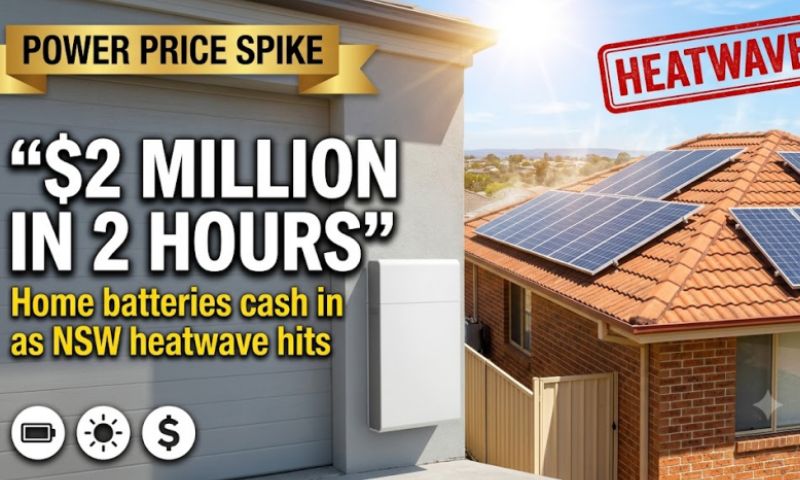
Sixty-nine bucks. That’s what the average Amber Electric customer made in about two hours last Monday arvo. They didn’t lift a finger. Their home batteries did all the work.
All up, around 30,000 households pocketed about $2 million, the ABC reports. A few made more than $500 each.
Why? A freak spring heatwave. The grid just wasn’t ready.
34.7 degrees. In October.
Observatory Hill clocked 34.7 that Monday. That’s more than 12 degrees above the usual October average.
Hot days normally aren’t a huge drama for the grid. But this one landed at a bad time.
“It’s normal for electricity prices to be high when temperatures go noticeably above 30 degrees,” said Tristan Edis, from Green Energy Markets. “What’s problematic is that doesn’t normally happen in October.”
Spring is when power stations usually get their maintenance done, ready for summer. Four of the state’s 12 coal units were switched off. Two more were running at reduced output. All up, roughly 2,400 megawatts of coal power wasn’t there, according to the market operator, AEMO.
Some big transmission lines were also down for maintenance. So power from wind, solar and batteries in southern NSW couldn’t get through to Sydney.
Then demand jumped by almost 2,000 megawatts inside an hour.
Prices hit the ceiling
Around 3:30pm, the wholesale price shot to $23,107 per megawatt hour. That’s the maximum the market allows.
Then it went nuts for an hour. Up, down, up again. They topped $5,000 in 11 separate five-minute periods.
That’s where home batteries came in.
Wait, batteries get paid?
Yep. Well, Amber customers’ ones do. On Monday they were selling power straight back into the grid.
Batteries pumped out power when prices spiked. When prices dropped, they pulled back. Then they jumped in again.
Amber co-CEO Dan Adams reckons it’s “probably” a record payday. His take? The big generators lose a slice. Ordinary households pick it up. “In the hands of individual households,” as he put it.
AEMO’s headache
Here’s the tricky bit. These batteries sit “behind the meter”. AEMO can’t actually see them or control them.
‘Thousands of homes flicking on and off. AEMO chasing its tail. Market designer Dave Smith said AEMO was “on the back foot”.
“Whenever you have a lag, you’ve always got this sort of whiplash problem,” he said.
AEMO boss Daniel Westerman doesn’t seem bothered about where things are heading, though. “Batteries, large and small, are fundamentally changing the way energy is produced, consumed and priced,” he said.
700,000 and counting
More than 700,000 home batteries are already installed across the country. AEMO expects that to pass 2 million by 2030.
Big grid-scale batteries have more than doubled in the past year, to over 9 gigawatts. Last quarter? Batteries set the wholesale price nearly half the time. Up from 18 per cent a year before.
And average wholesale prices have dropped 44 per cent in two years, from $133 to $74 per megawatt hour.
Should you get one?
A $69 windfall won’t pay off a battery on its own. Days like last Monday are rare, especially in October.
Got one already? Or tempted? Ask your retailer what happens on spike days. Some plans let your battery chase high prices. Others don’t.
Where to from here
Summer could be a bigger test. A potentially record El Niño could bring hotter, drier weather to south-eastern Australia. Will the coal stations hold up? Edis isn’t sure.
He wants more wind farms and more transmission lines. And AEMO? Still can’t see those garage batteries. That needs fixing too.
For now, though, about 30,000 households have a nice little story to tell over the barbie.