
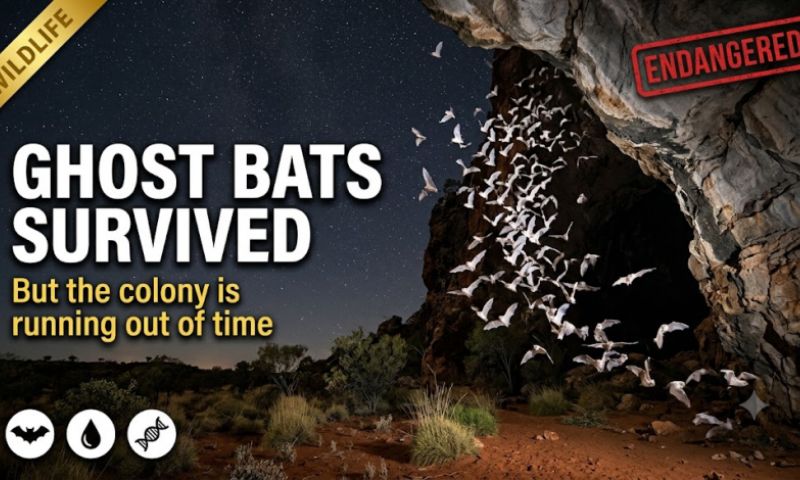
A pale ghost bat colony flying out of a dark limestone cave entrance at night in outback Queensland
Ian Saltmere watched the caves fill up one after another. Somewhere down in the dark? Endangered ghost bats. A whole colony of them.
It was 2023, and floodwater was pouring into the limestone country outside Camooweal, in Queensland’s far north-west. Saltmere says the water “started circling” like a whirlpool. Plenty of people assumed the bats had drowned.
They hadn’t. Not all of them, anyway.
A bat that eats other bats
Ever seen one? Probably not. Ghost bats are Australia’s largest carnivorous bat. White fur. An upturned nose. And a menu that would put you off your dinner: snakes, birds, and yes, other bats.
John Augusteyn knows them well. He’s a senior conservation officer with the Queensland Parks and Wildlife Service, and he told the ABC the bats can catch prey on the wing or sit on a perch “listening for their prey below”.
They’re found across northern and central Australia. Or they were. Cane toads, mining and disturbance to caves have left plenty of old roosting sites empty, and the species has dropped in both range and numbers.
The Camooweal network sits a couple of hours from Mount Isa. From the surface it’s not much to look at. Scorched country. A few limestone boulders. Underneath, it’s a maze.
Following the poo
Here’s the problem with studying ghost bats. You can’t just pop in and count them.
So researchers count the droppings instead.
Grant Pearce is the lead cave diver on the job. He and the team abseil into what he calls “large galleries big enough to fit several houses in”, collecting scat and prey remains so the environmental DNA (eDNA) can be tested. From that DNA they can work out roughly how many bats are down there. What they’ve been eating too. Even whether any of the females are pregnant.
It’s not glamorous work. Outside, it regularly hits 40 degrees. One trip down and you “sweat buckets of water”, according to Pearce.
Acoustic recorders are doing some of the heavy lifting too, picking up calls so the team can estimate how many bats are flying about. The project is co-ordinated by Queensland’s Department of Environment, Tourism, Science and Innovation, working alongside traditional owners and the cave divers.
So how did they survive?
Small pockets of air, most likely. Augusteyn reckons the bats rode out the flood deep inside the cave network, where trapped air gave them somewhere to breathe.
Preliminary testing has confirmed it. The bats made it.
Good news, right? Sort of.
The same tests showed the population is dwindling. Worse, the colony is cut off genetically from other ghost bats.
“Sadly, it’s a very low genetic diversity,” Augusteyn said.
And the kicker: “If they go extinct, there’s no chance of recolonisation.”
No backup colony waiting in the wings. If this group goes, that’s it for ghost bats in this patch of the outback.
A story older than the caves
For Saltmere, an Indjalandji-Dhidhanu traditional owner, the caves aren’t just habitat. His people’s Dreamtime story tells of a rough-tailed goanna that dug its hole and came out of the cave.
He wants them looked after. No ifs.
“It’s something to fight for,” he said.
Pet owners in the west are being asked to do their bit for native wildlife too, with cat curfews on the way in WA. Camooweal’s got different problems. Same idea, though.
Racing the wet
The wet season is coming, and that puts a clock on things. Rangers and researchers? Back out there early next year. More surveys. More DNA.
Full results? Not till later next year. And where and when these bats actually breed is still anyone’s guess. The team hopes to have a better idea by late 2027.
Meanwhile, there’s a 30-second clip doing the rounds. Night vision camera, cave near Camooweal. Out they come, pale as anything. Still here. For now.