
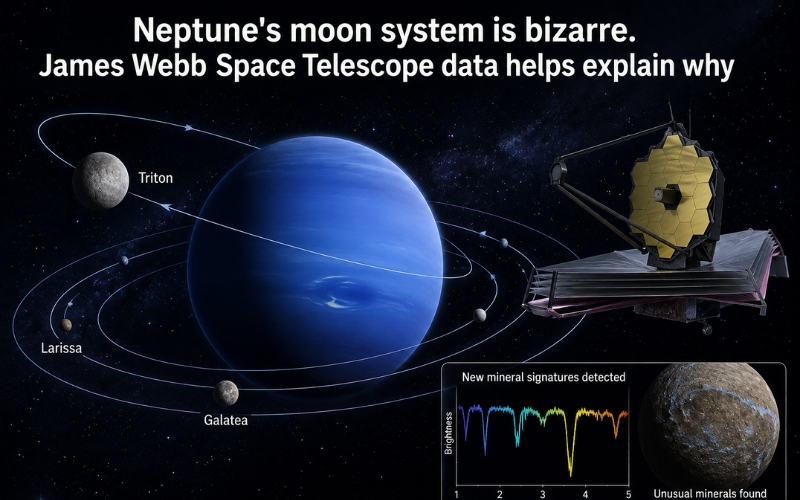
Neptune Moons have long fascinated astronomers because of their unusual orbits, mysterious chemistry and possible links to an ancient cosmic catastrophe. New observations from the James Webb Telescope are helping scientists understand how Neptune’s moons formed and why Triton remains one of the most unusual satellites in our solar system.
New observations from the James Webb Telescope are now aiding scientists in advancing toward a solution to this puzzle. With the help of high-powered infrared instruments, scientists have detected unexpected minerals on some of Neptune’s inner moons, making the planets “surprise” scientists about how they might have formed. Rather they may be the remnants of an ancient moon system that was obliterated due to Triton’s capture by Neptune in a retrograde orbit.
Why Neptune Moons Are Different from Other Planetary Systems
Neptune is very different from the other giant planets due to its odd assortment of satellites. The astronomers today recognize sixteen Total Moons, but they are no normal family.
The majority of large planetary satellites orbit in the same direction as the planet’s revolution. The orbit of the other planet, however, is retrograde, Neptune’s orbit rotating in the opposite direction. This is a very good indication that Triton did not form with Neptune, but was somehow captured from the far outer region of the Solar System many billions of years ago.
This caused probable gravitational turmoil. Neptune’s system of satellites may have been originally quite peaceful, but when Triton arrived, it disrupted the situation, sending many initial Moons out of the way and leading to collisions that destroyed many early satellites and scattered debris throughout Neptune’s environment. Eventually, some of this debris may have re-arranged itself to form the inner satellites we observe.
James Webb Telescope Reveals New Clues About Neptune Moons
Reason behind pointing the James Webb Telescope at Neptune was to detect unusual molecules or minerals at the surface of one of its most prominent moons, i.e., Triton. The infrared instruments of Webb’s are capable of detecting wavelengths of light absorbed by surfaces.
It studied the rings of Neptune, and a few small moons such as Larissa and Galatea. Due to their small size and the distance between Neptune and Earth, these objects are hard to study from Earth.
The telescope provided highly detailed spectroscopy data, which enabled comparison of the composition of these satellites with other icy satellites in the outer solar system.
Mysterious mineral spotted
The most surprising thing was not a new moon, but rather an unexpected mineral.
A team led by Dr Davis found another unique absorption line indicating the presence of the minerals typically found when rock reacts with liquid water over extended periods. This is the first time that these minerals have been found in Neptune’s inner moon system.
Strangely, the observations revealed very little sign of surface water ice, which is what one might assume, given Neptune’s far distance from the Sun where water ice should be the most prominent material.
Neptune’s inner satellites are chemically different from most objects in the outer solar system due to this mysterious mineral signature. These miniature moons are not just frozen worlds, but they seem to be a remnant of material that was originally found in much larger planetary formations.
The minerals found on the moon indicate a destructive origin
Now scientists believe that Triton’s huge gravity when it migrated to its retrograde orbit disturbed Neptune’s original satellite system. The big pre-formed planets crashed into each other and some of the smaller ones were ripped to shreds.
These results give rare proof that the materials at the inner moons of Neptune today may be the deep interiors of bodies that have long been destroyed, Dr Davis and his colleagues said.
Over the billions of years, most planetary moon systems are relatively stable. But Neptune may have had a much more dramatic event, and it is a natural laboratory for the study of planetary destruction and reconstruction.
The James Webb Telescope will continue to study Neptune, and it is likely to give new insights into its rings, atmosphere, and previously unknown chemistry. Further missions could also determine if the same processes formed the satellite system of other ice giant planets.
The road ahead
The odd chemistry of Neptune Moons, along with the remarkable tale of Triton’s captured retrograde orbit, suggests a picture of destruction followed by rebirth. It was a strange assortment of far-flung satellites that is now thought to be the remnants of a broken-up planetary system.
Scientists will be able to find out if more data comes from the James Webb Telescope, how many of Neptune’s Total Moons hold clues to this ancient catastrophe. As the researchers continue to make more observations, they are making progress toward understanding not only Neptune, but also the evolution of planets and satellite systems throughout the universe.