
What the Telescope in Chile Actually Saw
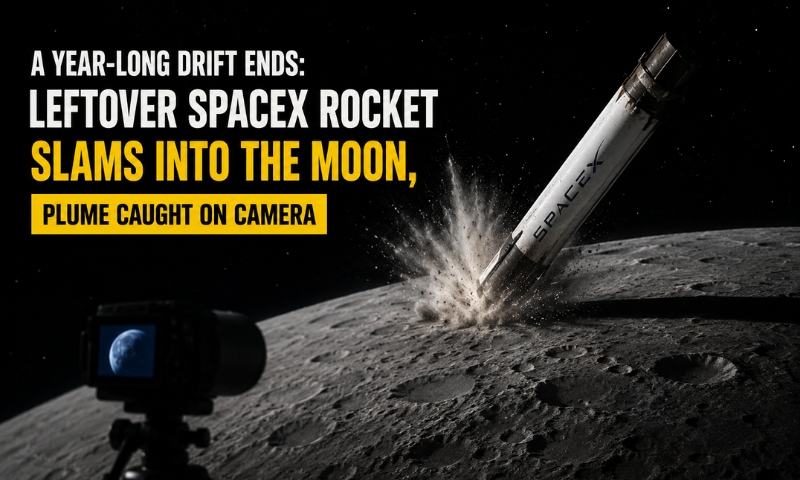
a wandering piece of SpaceX rocket has collided with the moon’s surface. It was confirmed by European Southern Observatory, located in Chilean desert. The impact was forecasted and was confirmed after large telescope in Chile noticed lunar dust and faint spectral signatures coming from the lunar surface.
It hit the far west side of the moon, where no observatory on Earth could see it, at some 5,400 miles per hour. A telescope in Chile did see the aftermath though: a short, luminous trail of material shooting up from the surface of the moon, right where astronomers had predicted.
A Piece of Space Junk Nobody Could Steer
The thing that was being sought after was not a mystery but an inconvenience. It’s the upper-stage of a rocket that SpaceX has used to launch its Starlink satellite internet network in January 2025 but left in orbit with its payload. It’s the top part of a SpaceX Falcon 9 rocket, a chunk of equipment, or about four tons, that we’ve already seen does its job back in January 2025.
Once a rocket stage delivers its payload, it usually doesn’t have any fuel to manoeuvre itself, and this stage was no different. This week it finally crossed the face of the moon, and it had been buzzing around for over a year and had been seen by both amateur and professional astronomers.
Space Junk Impacts like This Rarely Get Confirmed
Objects hit the moon more often than most people realize, mostly tiny meteoroids too small to ever notice. What made this event unusual was that it was predicted, tracked, and then actually confirmed, something that happens surprisingly rarely. Most rocket bodies and other space junk drifting through lunar space either miss the moon entirely, sail off into orbit around the sun, or strike the lunar far side where nothing on Earth can see the result. This particular piece happened to come down on the moon’s near-side edge, close enough to the visible limb that ground-based telescopes had a fighting chance of catching the plume, provided they were pointed at the right patch of sky at the right moment. That combination of a confirmed trajectory and a viewable impact point is what pulled this piece of space junk out of obscurity and onto the front page.
Cosmic Forces Steer a Dead Rocket toward Impact
Nothing about this crash was engineered. SpaceX could not have predicted the phenomena beforehand. It was predicted after the rocket piece was seen moving under the impact of gravity of the earth, moon and the sun. The stray piece was inevitably destined to get smashed against the lunar surface
Astronomers had modeled this outcome with enough confidence to know roughly where and when the impact would occur, even without any way to observe the actual collision as it happened.
Where It All Began: A Lunar Lander Mission
The SpaceX rocket stage traces back to a genuinely ambitious lunar Lander mission. The same Falcon 9 upper stage will also send two spacecraft to the moon in a single launch in January 2025, with the Blue Ghost Lander being built by Firefly Aerospace and carrying instruments for NASA, as well as a Lander developed by ispace of Japan. Blue Ghost successfully landed and completed its mission on the moon.
NASA had been preparing to do this data collection as it continues its efforts to learn more about lunar dust, lunar dirt and subsurface conditions in preparation for future crewed missions. The initial heavy lifting rocket stage was not intended to land anywhere, though. Once it released its cargo, it became just another piece of hardware left to find its own way through space, and this week that path ended on the moon.
A Small Crater in a Long-Term Problem
In practical terms, this impact changes nothing. It leaves behind a modest crater in an already heavily cratered patch of lunar dust near the moon’s western limb, doing no harm to any active mission. This shows how much space junk is around earth and moon.
As lunar Lander missions become more frequent in the years ahead, incidents like this one are likely to become less of a novelty and more of a routine footnote in the growing history of humanity’s presence in lunar space.