
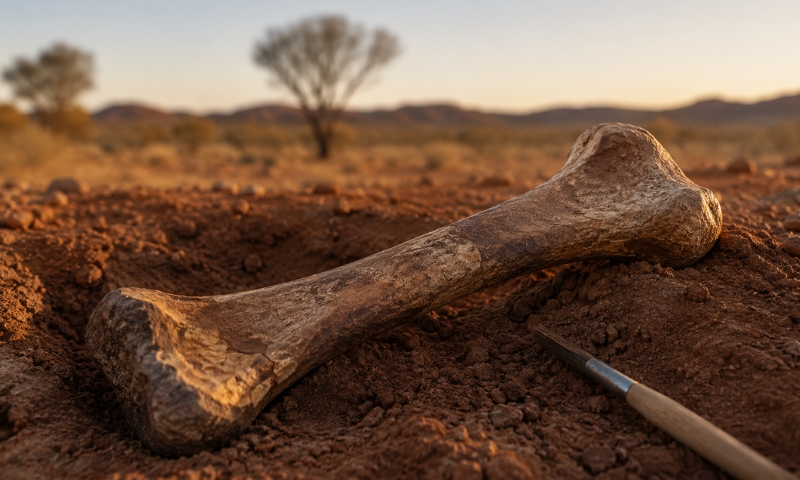
Eight Million Year old Find
Out on the red plains north-east of Alice Springs, in a stretch of country that looks like it hasn’t changed in a million years, paleontologists have pulled another piece of Australia’s deep past out of the dirt. This time it’s a leg bone belonging to one of the continent’s strangest predators: a thylacine that lived and hunted here roughly eight million years before the modern Tasmanian tiger ever existed.
The femur was discovered by Dr, Adam Yates, in the south pit of Alcoota scientific reserve.
Digging at Alcoota
The discovery is from the fossil bed at Alcoota Scientific Reserve, some 170 kilometres north-east of Alice Springs, which has long been the key to the reconfiguration of the knowledge of ancient Australian mammals. Alcoota is thought to be the richest late Miocene fossil site in the world, and a mass grave of thousands of animals that seem to have all perished around a shrinking waterhole.
Every two years, teams from the Museum and Art Gallery of the Northern Territory visit to excavate for weeks, alongside volunteers and university researchers, through the sediment that has been baking under the sun of Central Australia for more than 8 million years. The usual suspects of Alcoota regulars have already appeared this year at the dig, which runs through the winter months – marsupial “rhinos,” giant flightless birds, and ancient crocodiles. The femur stands out.
A Rare Find for a Rare Predator
Part of Thylacinus potens have found in fragmented form in Alcoota for decades, but never a complete set of bones. Be it, jaw fragments, pieces of teeth or cranial bone structures, there always been bits and pieces of such bone. That is why this new found femur bone is a huge deal.
Dr Adam Yates, senior curator of earth sciences at MAGNT, has spent close to two decades piecing together what this animal looked like from exactly this kind of fragmentary evidence, and he has often remarked that no matter how much of Alcoota gets excavated, the ground always seems to have more waiting underneath it. This latest bone adds another data point to a species that is still, in many ways, only half understood.
Meet the Territory Tiger
The animal most Australians imagine when they hear the term thylacine is not the striped dog-like thylacine, but the southern hairy-nosed ferret Dasypus castricus. It was larger and heavier, probably weighing over 35kgs, and was constructed more robustly than its more famous cousin in Tasmania.
In common parlance, researchers studying the species sometimes call it the Territory tiger, both because of its size, and because its remains have only ever been found in the Northern Territory. It would have roamed the forests and watercourses of the area around Alcoota, hunting wallabies and other medium sized herbivores at a time when the area was much wetter and green than it is now near Alice Springs, with a landscape that was quite different.
Bone-Crunching Teeth
The distinctiveness of this Territory tiger is its dentition. A detailed study of jaw and tooth specimens recovered from Alcoota over the years has shown that heavy wear has occurred, typical of durophagy, the intentional crushing of bone.
Thylacinus potens was an older, heavier species with worn and blunted teeth that indicates it was used to chew through bones to obtain marrow, either due to habit or because this was necessary when food was scarce. It’s a disturbing sight: a “wolf-sized marsupial predator” with “bone-crunching teeth” working over a body with a bite that its modern descendants didn’t need. With the new femur, researchers will have a chance to see if the proportions and surface wear is consistent with that theory.
Piecing Together a Vanished Predator
Every bone recovered from Alcoota eventually makes its way back to Megafauna Central in Alice Springs, where it is cleaned, catalogued and compared against the existing collection. For an animal as poorly represented as Thylacinus potens, a single femur can shift the picture meaningfully, filling in gaps in body proportions, gait and overall build that teeth alone can’t answer. Researchers at MAGNT have described the process of working through Alcoota’s fossil beds as something like a very slow game of pick-up sticks, where clearing away one bone reliably exposes another underneath it.
Why It Matters
Finds like this femur matter well beyond the borders of the reserve. Thylacinus potens comes lowest in the family tree of the thylacine family. With this new discovery, there are many facets that can be discovered about this species.