
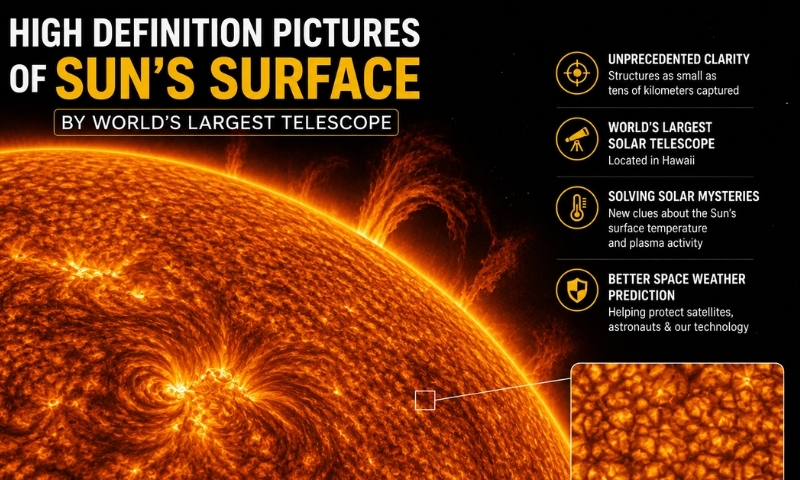
This week, researchers published images of sun’s surface and plasma in the highest-resolution ever recorded, resolving structures down to a few tens of kilometers across on a star roughly 150 million kilometers from Earth. The data, described in a paper published in Nature, offer the clearest observational evidence yet of a turbulent process that may help explain one of the longest-standing puzzles in solar physics: why the sun’s surface temperature is so much hotter than the layer beneath it. And this has only been possible because of world’s largest solar telescope
The Solar Telescope in Hawaii behind the Breakthrough
The telescope with a primary mirror of 4- meter and its aperture being central to its power, makes it current largest telescope in the world. It is located in Maui Island, Hawaii. Researchers led by Daniel K. Inouye were trying to calibrate the instruments optics and limits when they came across the high resolution imagery.
They reached the conclusion of images being the highest of resolution, because the data exceeded the quality of any previous image of sun’s surface.
What the Data Reveal
The resolution is so precise that we can clearly see the workings of plasma. In the images, sun’s surface radiates plasma, it then cools down and goes back in to the surface.
This convective churning is the primary mechanism by which thermal energy is transported from the sun’s core toward its outer layers. Along the boundaries of these cells, particularly in regions with concentrated magnetic fields,
It was due to the optical power of the largest solar telescope that fine striated structures were recorded. They had been theoretically predicted but never directly observed. Solar physicist Ruizhu Chen of Stanford University, who was not involved in the study, noted the visual resemblance of these patterns to the swirling brushwork in Van Gogh’s Starry Night,
Whirling Patterns on the Sun’s Surface
According to the analysis, those striated features are small-scale vortices that are common in fluid dynamics and known as the Kelvin-Helmholtz instability, which occurs when two fluid layers with different velocity shear against each other. It is the same instability that produces waves on the surface of the ocean and the ‘wavy’ edges of clouds on Earth but it operates over a scale of only tens of kilometers on the sun.
These whirling structures can only be by a powerful solar telescope. They are concentrated especially at the edge of magnetic structures, indicating a possible role for magnetic shear in the turbulence. The link is important because it could shed light on the decades-long puzzle of why the sun’s outer atmosphere is hotter than its surface, which has been a favorite of solar scientists. Instead of assuming the form of a model, it is possible to directly image this turbulence for the purpose of comparing the resulting data with existing models.
The Sun’s surface temperature remains a mystery
One of the long-standing mysteries of solar physics is the sun’s surface temperature, about 5,500°C, versus the temperature of the corona above, which can reach more than one million degrees. In normal thermodynamic terms, the temperature should lower the farther away it is from the energy source, but this is not the case with the sun’s surface temperature and the more distant corona’s.
The new observations of sun’s surface & plasma indicate that turbulence and magnetic reconnection close to the photosphere could release energy in short, small-scale events. This allows the corona to heat up from below over a longer period of time. This is not yet an exhaustive explanation, but it is the most direct observation-based evidence yet of a mechanism that has been suggested in a theoretical model.
Predicting Space Weather
This info may sound insignificant to regular folks, but they shed light on many phenomena’s, which can make the lives of astronauts and scientists quite safer. And this has only been possible because of world’s largest solar telescope
These observations have scientific significance rather than restricted to fundamental physics. The magnetic energy stored on the Sun is occasionally released as a solar flare or coronal mass ejection, which can cause satellite outages, interfere with radio communications, and cause damage to power stations on the ground. The telescope was built specifically to aid this objective, and the sun’s surface temperature is not just something to observe, but a system whose activities need to be modeled and predicted, according to the National Solar Observatory that operates it.