
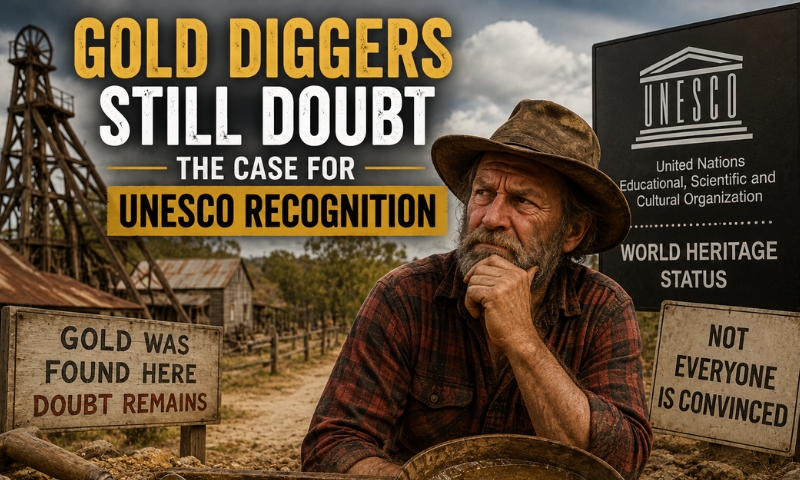
Ask a weekend fossicker in Bendigo or Ballarat what they think of the push to get the Victorian goldfields onto the world stage, and you’ll usually get two answers in the same breath. Pride, first — these hills are woven deep into Victoria’s gold rush history. Then suspicion, close behind, about what happens once the paperwork is signed. That tension has followed the bid for years, and it hasn’t gone away.
A Community Split over the World Heritage Push
Local people here hold a Victorian miner’s right since the riots of 1850’s, who still search these Victorian goldfields where there grandparents worked. There are more than 115,000 with such rights. So when talk turns to UNESCO and the possibility of a listing for the Victorian goldfields, it isn’t an abstract policy debate for this crowd — it’s personal.
The Prospectors and Miners Association of Victoria says a good number of its members remain wary. Officials insist a UNESCO nomination carries no legal weight and won’t touch existing mining permits, but that reassurance hasn’t fully landed. Distrust of government runs deep in a subculture that still traces its roots to the Eureka Stockade rebellion, and plenty of prospectors would rather wait and see than take the promises at face value, given how central Victoria’s gold rush remains to local identity.
Why These Sites Matter to Victoria’s Gold Rush History
The history is not bound to only one site: Castlemaine’s alluvial diggings, the deep-lead workings around Creswick, Bendigo’s Victorian-era streetscape, the Great Nuggets landscape, the alpine mining town of Walhalla etc.
All of these places have deep significance for the local people. Together, backers argue, they tell a more complete version of Victoria’s gold rush history than any single museum or monument could.
What sets the story apart internationally, according to heritage advisers involved in the bid, is what didn’t happen here. Unlike comparable rushes in North America, large mining corporations were largely kept out of the diggings in the decades that followed, so the pick marks and hand-dug tunnels of individual prospectors survived largely untouched. Combine that with the region’s volcanic geology — ancient lava flows that buried and preserved gold-bearing riverbeds for generations — and you get a landscape that heritage experts describe as unusually intact for its age. It’s a big part of why supporters believe Victoria’s gold rush history deserves recognition well beyond state or national borders.
What World Heritage Status Would and Wouldn’t Change
The practical question keeps coming back to land use. Backers of the bid, including former premier John Brumby, have long argued that World Heritage status has no bearing whatsoever on planning schemes, council regulations, or the rights attached to a miner’s permit. On paper, a listing simply recognises a place’s cultural significance to UNESCO and the wider world, celebrating Victoria’s gold rush without handing anyone new powers over what happens on the ground.
Even so, some prospectors aren’t fully persuaded. Concerns linger that once a site carries international prestige, informal pressure to restrict access could follow, even without a change in the law. Association leaders have spent hours on the phone talking members through the fine print, and while many have come around, others remain firmly opposed, arguing that the very qualities that make these sites worth protecting are best preserved by leaving prospectors free to keep working them.
The Long Road Still Ahead for the Victorian Goldfields
Timelines have also shifted. The Victorian goldfields were added to Australia’s official tentative list, the first formal step toward a full nomination, but the pathway from there has grown longer than early advocates expected. A newly introduced preliminary assessment stage now sits between the tentative listing and a full nomination, and by recent estimates that preliminary step can’t begin before September 2026, with a report back from the World Heritage Centre not expected until late 2027. A full nomination submission is now unlikely before 2028, pushing any possible listing out toward the 2030s.
Fifteen local councils, Heritage Victoria and the state government remain behind the push, and organisers say the added time is being used to keep talking with communities and stakeholders across the region. Economic modelling commissioned for the bid suggests a successful listing could bring hundreds of millions of dollars in regional visitation and investment over time — numbers that matter in towns where Victoria’s gold rush history still shapes the local economy.
Where This Leaves the Prospectors
Whatever the outcome, the debate itself says something about how this part of Victoria sees its own past. Victoria’s gold rush wasn’t just an economic event — it shaped towns, identities and a lingering wariness of authority that still surfaces whenever outsiders propose changes to the land. Whether that history ends up carrying a UNESCO stamp or not, the prospectors digging these hills today clearly intend to keep having a say in how their story gets told.