
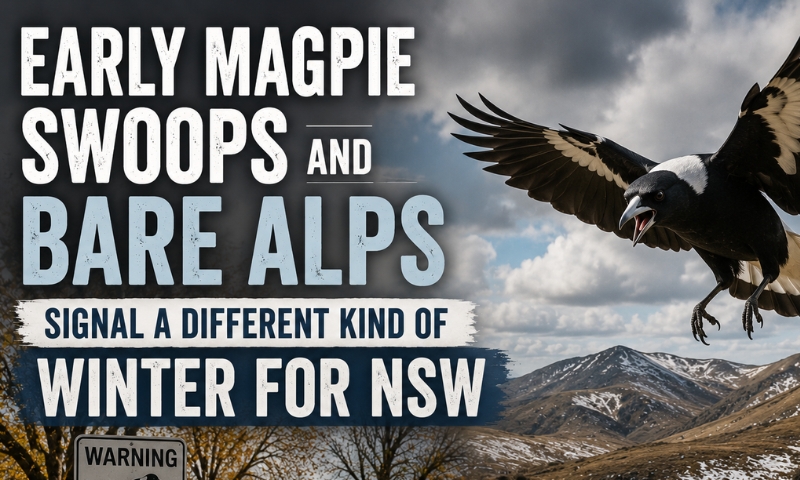
Early magpie entry in New South Wales this winter is an alarming concern. Canola paddocks were flowering weeks ahead of time, ski resorts were struggling to hold onto snow, and in towns like Wagga Wagga, people were already seeing spike in magpie sightings before winter had properly settled in. Put those clues together and you get a fairly clear picture: this has been one of the warmest, driest starts to winter NSW has seen in years, and this year’s El Nino is largely to blame.
A Magpie Swooping Season That Arrived Too Soon
Magpie swooping season is usually a spring problem. Nesting typically kicks off around August, with the most aggressive swoops landing in September as protective birds guard their chicks. This year, cyclists and joggers in regional NSW reported being dive-bombed as early as July — a full month or more ahead of schedule.
Ornithologists say the shift makes sense once you factor in food supply. A magpie generally holds off breeding through the coldest months because there simply aren’t enough insects around to feed hungry chicks. Warm up the ground even slightly, though, and insect activity picks up fast, giving a magpie every reason to start nesting — and defending that nest — earlier than usual. Researchers who study the species say repeated early swooping seasons like this one could gradually reshape magpie breeding patterns across the state over the coming years.
Why El Nino Is Reshaping This NSW Winter
The Bureau of Meteorology made its earliest-ever El Nino declaration this year, confirming what forecasters had been watching build for months. High pressure winds created by El Nino create clear skies and less chances of rain. This effect the winter season that kicks off in July and August, in New South Wales. Following this, dry conditions in state are stretched for a longer period of time.
Numerous weather stations across NSW logged record or near-record June readings this year, and the state’s average June temperature ranked among the warmest in more than three decades. Climate scientists describe this as exactly the kind of outcome El Nino years tend to produce here — warmer overnight lows, drier air, and conditions some forecasters have started jokingly calling “sprinter,” a blend of winter and early spring arriving at once.
Blossoms Arriving Ahead of Schedule
Plant life has responded just as quickly as the magpies. Botanists report flowers opening in early August that would normally wait until spring, and along the Riverina’s canola trail, growers say this year’s blooms came in noticeably early thanks to the warmer winter running through the region.
Early flowering isn’t purely good news, though. In cooler inland pockets like Canberra, a warm spell that tricks plants into blooming too soon can be followed by a late frost that wipes out the fruit set for the season. Due to longer flowering windows plants will draw more heavily on water and nutrients. So gardeners and farmers are being encouraged to keep a closer eye on soil moisture and feeding schedules than they might in an otherwise normal year.
A Rough Start for the Snowy Mountains
Nowhere has this mild, dry stretch bitten harder than in the Snowy Mountains. Resorts opened in June with only patchy, mostly machine-made cover, as overnight temperatures stayed too mild for reliable snowmaking and rain washed away what little natural snowfall arrived. Forecasters have pointed to this year’s El Nino as the main culprit behind the sluggish snow season, since the same high-pressure pattern suppressing rainfall statewide also tends to steer cold fronts away from the Alps.
Long-range outlooks suggest the NSW Main Range still has a reasonable shot at solid totals later in the season if a few strong cold fronts push through, but forecasters are candid that this snow season is shaping up as one of the leaner years on record for lower-altitude resorts. It’s a pattern experts expect to become more familiar: modeling suggests snow cover across the Australian Alps could shrink substantially in coming decades as background warming compounds the swings brought by events like El Nino.
What It All Adds Up To
Taken individually, an early magpie swoop or a slow start to the snow season might read as one-off quirks. Taken together, they’re becoming a recognizable seasonal fingerprint for NSW — a warmer winter nudging wildlife, plants and alpine tourism alike a little further off their usual calendar each year. Whether it’s magpies nesting early, canola blooming ahead of time, or thin snow at Thredbo and Perisher, the through line is the same: NSW’s winters are shifting, and this year’s strong El Nino has made that shift impossible to ignore.