
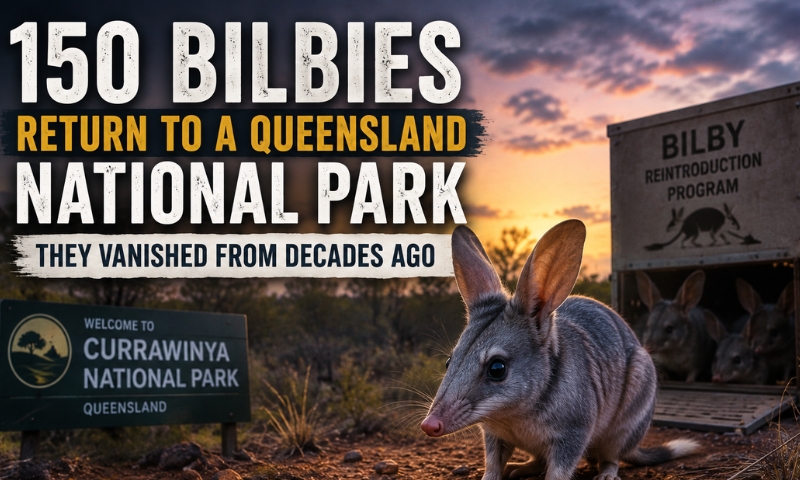
Decades of efforts came to fruition when 150 bilbies were released back into National park Queensland. Since 1970’s the species were prone to get caught by vehicles on the road or predators. Due to this they almost came to verge of extinction, but that is not the case today.
A Historic Night for Bilbies in Outback Queensland
Save the Bilby Fund CEO Kevin Bradley has done this before, but he says the nerves never quite go away. Standing in the dark, freeing bilbies from their carry bags, he describes a rush of emotion that catches him off guard every time — equal parts relief and disbelief that the moment has finally arrived. It took roughly a decade of planning, breeding and predator control to get here, and over six nights, around twenty volunteers helped release the animals into open country, well outside the safety of the fence that had protected earlier generations.
It marks the first time bilbies have gone back into truly wild, unfenced ground in this National Park Queensland reserve, after being locally wiped out here for more than fifty years. For a species that has lost roughly four-fifths of its former range across the country, that alone makes it a landmark moment for bilbies Australia-wide. It’s the kind of result that feeds directly into recovery efforts for bilbies Australia-wide.
Why National Park Queensland Was Chosen
The site is Currawinya, a section of mulga country and sparkling salt lakes in south-west of the state where bilbies have remained hidden for years and years, making it one of Australia’s most significant bilby breeding grounds. This site in National Park Queensland was chosen decades ago for a very good reason – it was made up of exactly the sort of remote, undisturbed habitat bilbies require and was large enough for a recovering population to expand.
This was fenced off to prevent feral cats from predating bilbies in 2003, and a predator-proof fence was erected here, covering about 25 square kilometres. For several years, that barrier had been established and then the cats got through in 2010, for a brief period. Rebuilt and reinforced short after, it’s been an estimated 1000 animals that have since populated the protected area of the National Park, proof, Bradley says, that the National Park had done exactly what it was designed to do.
Decades have gone to build the right habitat for bilbies
It took years to create the first functioning bilbies habitat by trapping and removing feral cats, monitoring rainfall and vegetation. Rangers and volunteers have used tools like remote cameras and automatic cat detection traps to keep them safe. All the lessons learned here are applicable to strategies for bilbies across Australia and beyond, applicable to other projects far removed from Currawinya.
The bilbies themselves have at times taken matters into their own paws, as will be discussed. There have been a few that have escaped through the fences since 2021 and have established their own life on the outside, apparently doing well despite the dangers. The barrier was never intended to keep the animals from getting out, but was meant to exclude predators.
The New Population is being tracked outside of the fence
Queensland Parks and Wildlife Service conservation officer Steve Peck says his team will closely monitor the newly released group, via tracking collars, motion-sensor cameras and burrow counts. Bilbies are boom-and-bust breeders, and when the rains are good they grow rapidly, but when they are lean they can withdraw strongly when the time comes to release, which is why it was not a coincidence that the time of release coincided with the period of good rains.
Over the years, the wild population at this National Park has dwindled to almost nothing so much so that Peck hopes this is not just a single time release, but a first step. He has a long-term wish to make, and it’s a simple one: that one day when visitors are driving through the park, they’ll have to slow down to see a sign saying bilbies are crossing the road.
What This Milestone Means for Bilbies Australia-Wide
For now, though, the focus stays local. If this group of 150 survives its first dry spell outside the fence, it will prove that a properly managed, unfenced National Park Queensland landscape can once again support a wild bilby population — something that hasn’t been true here for half a century. That’s a big claim to test, but for the volunteers who spent six nights kneeling in red dirt with hessian bags in hand, it will be one more data point in the long, patient effort to safeguard bilbies Australia-wide for good.