
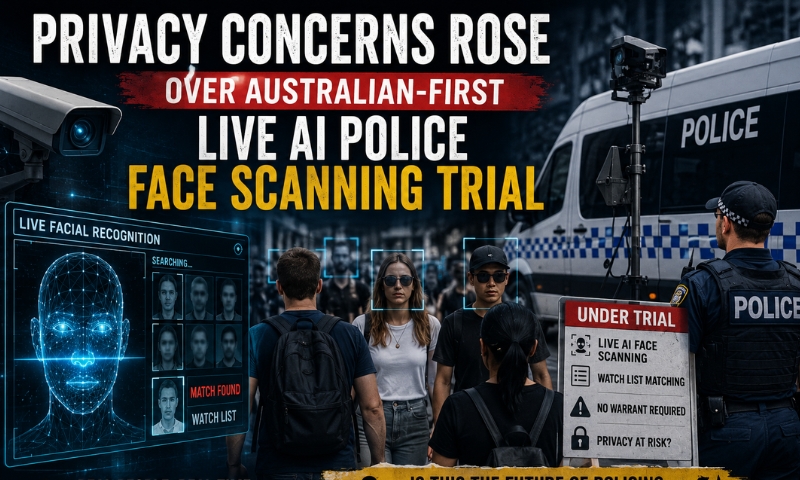
The country’s first live, real-time facial recognition trials run out in the open, on ordinary streets, on Aboriginal people. When WA Police switched on cameras across Perth and Fremantle in June, most people walking past probably didn’t notice the sign taped to a nearby van.
Within a week, more than 130,000 faces had been scanned and quietly checked against a police watch list. Officials called the results promising. Privacy lawyers, human rights advocates and the state’s Aboriginal legal service called it something closer to an experiment nobody outside the force had properly agreed to.
What the Trial Is Actually Testing
The system uses NEC’s Neoface m40 software, paired with cameras mounted near a mobile van that officer’s monitor from inside. Every face that walks past is compared, in real time, against a list of roughly 4,000 people, a mix of outstanding warrants, missing persons and individuals considered a risk to themselves or others. If there’s no match, the image is pixilated on the operator’s screen and deleted almost instantly, according to the force. If there is a match, an alert goes out and officers move in.
In its first week, the trial produced 33 alerts and 18 arrests, with only one false match recorded. WA Police pointed to that figure as proof the facial recognition system works. Critics were less impressed, noting that a single week of data from a live rollout tells you very little about how the technology behaves over months, across different lighting, weather and crowd conditions, or across different faces.
Why Aboriginal People Are at the Centre of the Debate
The training data given to such AI is a major concern as well for aboriginal people. It has history to perform worse on people who have darker skin or are non-whites. No one can say that facial recognition technology has been tested for all races and skin tones. WA police has not answered these questions as well.
What’s made this harder to ignore is where the cameras have actually been placed. Deployments have concentrated in Northbridge, Midland and similar inner-city areas are places widely known as spots where Aboriginal people gather or pass through regularly. Peter Collins, legal services director at the Aboriginal Legal Service of Western Australia, has argued that this pattern couldn’t be accidental. He’s pointed to WA’s already high rates of incarceration among First Nations people as reason enough for far more caution than police have shown.
WA Police’s own privacy paperwork claims the trial won’t disproportionately affect Aboriginal people, and a spokesperson insisted site selection was based purely on “policing need,” not any particular group.
ALSWA Says It Was Left Out of the Room
Consultation, or the lack of it, has become its own flashpoint. ALSWA says its first contact from police wasn’t a meeting or a briefing paper; it was an email asking for twenty minutes of Collins’ time, sent two days before the trial launched. Given who the technology was most likely to affect, that timeline struck the organization as closer to a formality than genuine engagement. Collins has described it plainly as a box-ticking exercise, arguing the trial was going ahead regardless of anything the legal service might have raised.
WA Police maintains it made efforts to reach the organization. But the broader pattern is, thin outreach to the legal body most likely to hear from affected communities, plus a privacy watchdog that says it was never properly consulted either. It has left both regulators and advocates asking why a program this significant moved so fast with so little outside scrutiny.
Accuracy Still Varies by Demographic Group
Academics researching the technology point out that accuracy aren’t fixed -it shifts depending on the demographic makeup of who is being scanned. Camera settings and real-world conditions like poor lighting or partial obstruction are also a major concern. A study done in UK (2023) showed that algorithm was able to work properly tightly controlled conditions. But it has been seen that live unpredictable footage doesn’t have accuracy
For now, though, that data hasn’t been made public, and both ALSWA and independent researchers say they’re being asked to simply trust the process.
What Happens From Here
Other Australian police forces are reportedly watching WA Police closely, and the outcome here could shape how facial recognition spreads nationally. Privacy advocates argue the state’s current laws simply weren’t built with this kind of surveillance in mind, and that oversight needs to catch up before the technology expands any further. Until more detailed, group-specific results are released – and until bodies representing Aboriginal people get a genuine seat at the table, the questions raised since June aren’t likely to go away.