
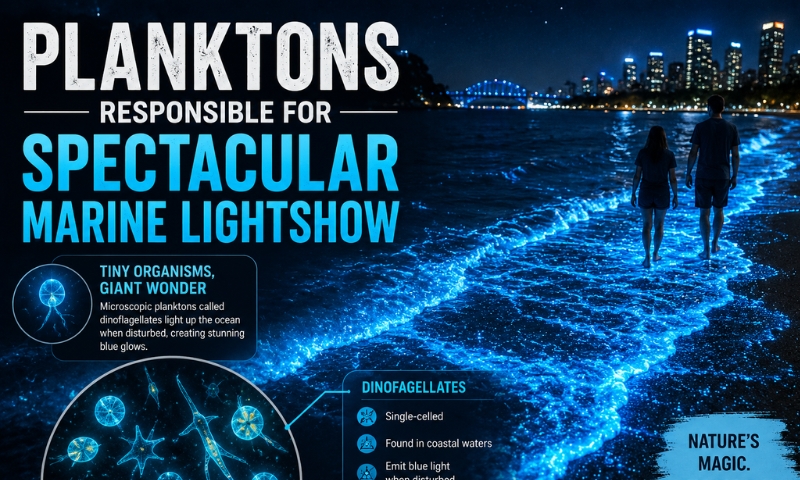
It’s a common sight in Brisbane for people to see flares of electric blue around their feet when they are walking the ocean. It looks strange and beautiful at the same time and is simply a natural phenomenon of bioluminescence. It isn’t a chemical spill or a hoax filter. It’s one of the ocean’s stranger party tricks, produced entirely by organisms too small to see with the naked eye.
What is causing the water to glow?
Bioluminescence is the phenomenon of light produced by a living organism’s body as a result of a chemical reaction rather than reflection or absorption of light. Typically in the sea the glow is from a cluster of small plankton (dinoflagellates) and one particular species around the Australian coastline receives most share of the credit – it’s called Noctiluca scintillans or sea sparkle as it is commonly known.
They’re single-celled and reside on the blurry line between plant and animal. When they are in the sun, they act like a plant and photosynthesise. However, they also consume even smaller organisms such as diatoms which they act more like a mini predator. If a wave, a paddling foot or a boat hull disturbs a cell, a chemical reaction creates a short flash of blue light within the cell. Each of these cells alone will produce only a slight flicker. However, when they gather in a bloom close to the coast the result is as if the whole ocean is a giant ball of fairy lights.
Why It Turned Up Around Brisbane
Recent footage taken at boat ramps around the city put the phenomenon back in the spotlight, with clips from spots including Pinkenba circulating widely online. Researchers at Griffith University say south-east Queensland does see it, though nowhere near as often as further south. The lower Brisbane River is one known local hotspot, with blooms more likely to appear during the cooler winter months when conditions in the water shift in the plankton’s favour.
Seeing it well comes down to a mix of timing and luck. A pitch-dark night without much moonlight gives the glow its best chance to stand out, and arriving a couple of hours after sunset tends to work better than heading out right at dusk. Even with ideal conditions, though, scientists studying the phenomenon admit there’s no guaranteed formula – sometimes the bloom shows up, and sometimes it simply doesn’t.
New South Wales Remains the Country’s Bioluminescence Hotspot
This phenomenon can be seen in Brisbane quite a lot, but it is most impressive in New South Wales. A few hours south of Sydney, Jervis Bay has earned a bit of a reputation for it and there has been an abundance of displays of bright blue in recent years on beaches such as Barfleur, Callala Bay and Plantation Point. This area of the NSW coast is exceptionally favourable for high concentrations of dinoflagellates due to the sheltered shallow waters, the lack of light pollution and the high nutrient loads from rain.
In recent years there has also been an increase in sightings in Tasmania that scientists have speculated may be due to changing water temperatures associated with climate change, but which are not yet fully understood. Both Queensland and Tasmania are more sporadic, weather dependent sites for bioluminescence, in comparison with the reliability of its appearance in NSW.
Is It Safe to Swim In?
A glowing tide doesn’t necessarily mean a bad water quality. Bioluminescence, on its own, isn’t normally a sign of pollution or an unhealthy waterway, and there’s no reason to fear it, according to marine ecologists. The message is to be alerted by any local council water-quality warning, but not when the light is on.
Scientists studying the phenomenon also rely heavily on the public to help track it. Because these blooms are unpredictable and mostly visible only at night, official water monitoring rarely catches them in the act – meaning phone footage and social media posts from beachgoers, whether filmed near Brisbane or along the New South Wales coast, end up doing a lot of the heavy lifting for researchers trying to understand when and why it happens.
They are not the only ones
The same kind of bioluminescence is show by a number of marine organisms, like squids and copepods. There are even some shark species in Deep Ocean that show similar bioluminescence like the microscopic plankstons (dinoflagellates).
In the deep ocean, where sunlight never reaches, it’s sometimes the only light source going, doubling as both a warning signal and a lure for prey. But for most people standing at the water’s edge on a dark Australian night – whether that’s a suburban boat ramp or a quiet NSW beach – it’s the smallest performers, a few million single-celled dinoflagellates lighting up in unison, putting on the biggest show.