
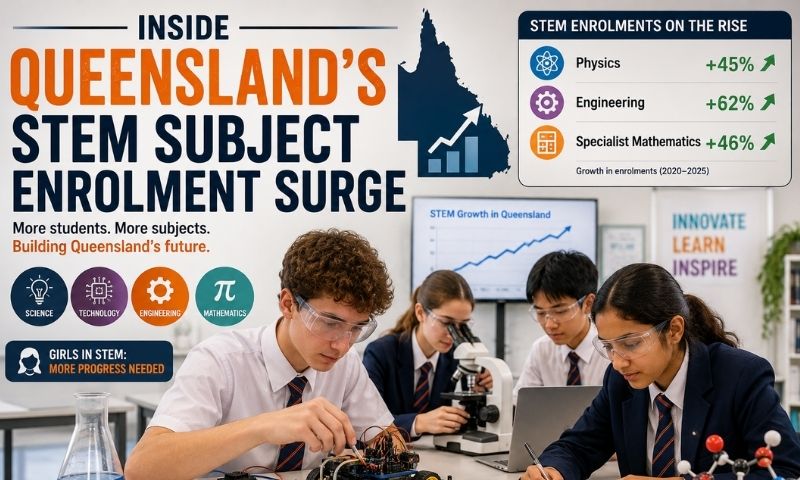
The number of STEM subject enrollments increasing in classrooms across the Sunshine State. Queensland Curriculum and Assessment Authority have stated that STEM enrolments are sliding nationally. In the last 6 years, it has been seen that more students north of the Tweed are choosing physics, engineering and specialist mathematics.
The numbers are good, though one question still remains, “Why aren’t there more girl students in these STEM subjects”. They are still not properly represented in these fields.
The Numbers Behind the Surge
The national total of students enrolled in STEM subjects at year 12 reached a national peak of approximately 406,000 in 2015 and then decreased to about 376,000 in 2016. In contrast, this is a complete turnaround in Queensland.
The Queensland Curriculum Assessment Authority’s own subject reports have found that the number of students enrolled in physics has increased by approximately 45 per cent from 5,817 in 2020 to a total of 8,453 by 2025. This compares to 13.3 per cent and 9.7 per cent growths, respectively, in New South Wales and Victoria over the same period, making the state’s positions, particularly in physics and specialist mathematics, appear badly out of sync with the rest of the country.
Specialist mathematics has followed a similar path. Enrolments in specialist mathematics grew by 46 per cent, while engineering did even better, up 62 per cent, per figures published by the Queensland Curriculum and Assessment Authority. Not every STEM subject shared in the boom, though -environmental science, agricultural science and digital solutions all went backwards over the same period, a reminder that “STEM” isn’t one trend but several running at different speeds.
Why the State Might Be Bucking the Trend
Susan Burchill, who runs education and outreach programs for CSIRO, isn’t shocked by the numbers, but she is pleased by them. “It’s so good to see enrolments increasing here, and we hope they’ll increase across the country,” she said.
Part of CSIRO’s approach is starting early, well before students are choosing year 12 subjects. “We really need to start earlier down that pipeline and inspire students in primary school and even early childhood to think about STEM and show them the opportunities,” Burchill said. At CSIRO’s robotics innovation centre on Brisbane’s outskirts, that means letting kids get hands-on with robots -including two built to demonstrate real engineering problems rather than sit behind glass.
Things that haven’t Changed
Here’s where the good news runs out. Girls remain significantly under-represented across most STEM subjects in the state, including specialist mathematics, and the growth in overall enrolments hasn’t closed that gap nearly as much as anyone would like.
In physics, female representation has edged up to about a third of enrolments. In specialist mathematics, girls make up just under 40 per cent -closer to parity, but still a minority. Flip to biology or chemistry and the pattern reverses almost entirely, with girls making up around seven in ten biology enrolments and just over half of chemistry.
Professor Robyn Gillies, from UQ’s School of Education, says universities and education departments are “doing what they can” but progress has been slow. “There is a little bit of a concern that we’d like to see that gender gap narrow,”
Gillies says the fix has to start with confidence, not just access. ” we are trying to empower girls so that they can have the confidence to tackle these courses and have little to no problem while they are doing that.”
What Comes Next
The Department of Education points to a range of initiatives it says are lifting engagement across STEM subjects generally, with figures drawn from the Queensland Curriculum and Assessment Authority showing the proportion of students studying physics and mathematical methods rose by three percentage points between 2021 and 2025. Programs like the state’s STEM Girl Power initiative and the Women in STEM Prize are specifically aimed at the gender side of the equation, giving younger students visible role models rather than just encouragement from the front of the classroom.
Whether that’s enough to shift the numbers meaningfully remains to be seen. Queensland has proven it can grow STEM enrolments overall -the harder task now is making sure that growth is shared evenly, rather than concentrated among the same students who were already inclined to sign up.