
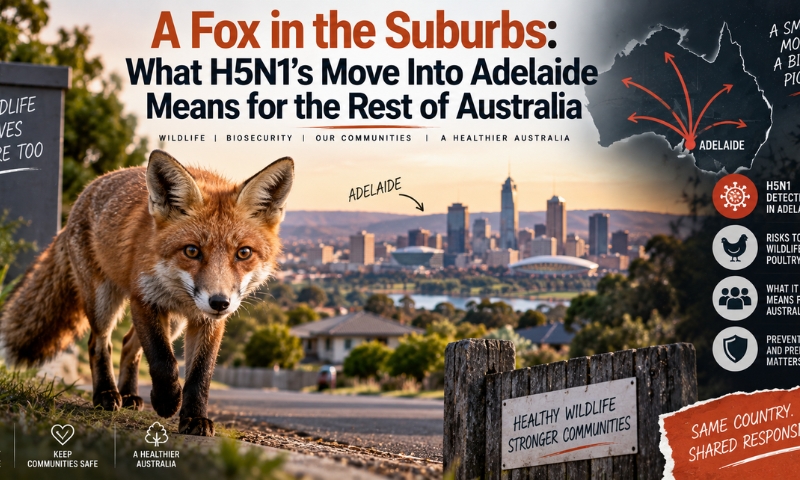
H5N1 virus victims has been increasing in Australia from past several months. Birds, Penguins in care and even seals have been affected by this virus. Now a suburban fox in a coastal suburb has changed the shape of that story completely, and wildlife authorities nationwide are watching closely to see what comes next.
The fox was found in sand dunes at Osborne, a quiet coastal suburb in Adelaide’s north-west, showing signs of illness before it was collected by officials and euthanased. Samples have gone to a national laboratory in Geelong for confirmation, but if the result comes back positive, it will mark the first time this strain of bird flu has turned up in a land-based mammal anywhere in Australia.
Adelaide’s fox becomes the new face of a spreading outbreak
The Osborne fox wasn’t reported in isolation. It was one of five new suspected cases logged in a single day, alongside an Australian raven at Robe, a little penguin at Southend, a greater crested tern at Coonalpyn and a Pacific gull on Kangaroo Island. The capital itself has become something of a hotspot in this outbreak, with authorities in the metropolitan area now watching wildlife, pets and livestock with far more urgency than a few months ago.
South Australia’s Primary Industries Minister, Clare Scriven, said the fox case wasn’t exactly a shock. Foxes are scavengers by nature, and if one eats a bird carrying the virus, infection is a fairly predictable outcome. There can be harm, however, in predictable, so when you say “predictable,” what do you mean?
PIRSA tracks H5N1 as case numbers climb
The state’s Department of Primary Industries and Regions, known widely as PIRSA, has been the agency fronting daily updates since the outbreak began. The Department of Primary Industries and Regions now records suspected infections as “events” rather than counting individual animals, a shift that reflects just how many sightings staff are dealing with. According to PIRSA, more than 300 H5N1 infection events have been logged across the country since the first detection back in June, with South Australia carrying the heaviest load at roughly 195 confirmed cases.
The concentration in one state is indicative of the spread of the virus. It was believed to have been introduced from overseas by migratory seabirds, and established along the coast before it began to spread through resident birds inland. If the fox case is confirmed, it’s the next logical step: birds to the animals that eat them.
Why a fox worries scientists more than another dead seabird
University of Sydney veterinary public health expert Michael Ward has described foxes as a transmission “bridge species,” and it’s easy to see why. If a carcus is infected with the virus, it can be spread way beyond the coat via many scavengers like red foxes.
Australia’s red fox population is estimated at 1.7 million animals spread across roughly 80 per cent of the continent, which gives H5N1 an enormous amount of terrain to travel through if the virus does establish itself in land mammals. Officials from the Department of Primary Industries and Regions say monitoring will need to expand accordingly. Farmers have already started asking questions.
Pets, poultry and native wildlife needs to be protected
The virus has not been found in any big or small commercial poultry anywhere in the country. Even so, South Australians have been urged to keep dogs on leads away from sick or dead birds and to keep cats indoors, partly to protect native wildlife and partly to protect the pets themselves.
Vaccination efforts are also underway in pockets of the state. Cleland Wildlife Park, a short drive from the city, has begun vaccinating around 30 bird species held in its aviaries, while open-range colonies, such as the little penguins on Kangaroo Island, present a trickier challenge simply because wild birds can’t be tracked or recalled for a second dose.
What comes next for Australia’s outbreak
The Osborne case is still under investigation, but the implications are spreading out. If the infection is picked up by a land mammal in the suburb of a capital, it means that H5N1 is no longer restricted to remote coastlines and seabird colonies. It’s edging closer to backyards, farms and the animals people share their lives with, and authorities say the coming weeks of testing and monitoring will show just how far that shift has already gone.