
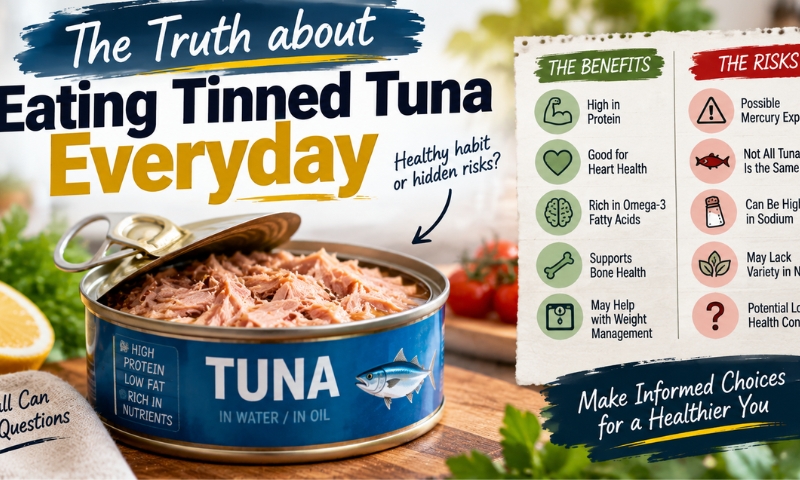
Nothing is as trustworthy in an Australian pantry as a tin of tuna. No need for cooking and it adds so much flavour to a plain sandwich, it’s cheap. However, there are many individuals who are working on it every day and wonder whether it is helping them or if they are slowly developing something that isn’t. Most would expect the answer to be less reassuring, but nutrition researchers say the short answer is more reassuring.
So what makes Australians so fond of a tin?
The lunchbox must-have is for a very simple reason: convenience combined with nutrition. One can provides a good dose of protein, and doesn’t need a stove, a chopping board, or a lot of time. Tinned fish may have been around for a long time, but it has certainly been a staple of life in Australia for many years – and for Australians anyway, it seems it never went out of fashion despite the rise and fall of other convenience foods. Well, it’s about mercury and whether or not regular consumption equals a gradual dose of more than is beneficial.
Calculating the volume of mercury in a tin of tinned tuna
Mercury is found in nature, and can be released into the environment during volcanic activity, weathering of rocks, and other natural processes. It is converted to methyl mercury in water by bacteria and then ingested by fish. Larger, older fish that are higher on the food chain build up more of it throughout their life cycle, so shark, swordfish and marlin have higher levels of mercury than do smaller fish. The majority of the Australian product is sold from younger and smaller skipjack and Yellowfin, both with significantly lower levels of mercury. That’s important when considering how much of this pantry staple can you safely consume.
The PTWI has been established by Food Standards Australia New Zealand (FSANZ)
Food Standards Australia New Zealand uses international guidelines to establish a guideline value called provisional tolerable weekly intake (PTWI), which provides an estimate of the amount of mercury that does not give the consumers a significant increase in risk to health if it is consumed weekly. That limit for most adults is 3.3 micrograms per kilo of body weight a week and pregnant women, about half of that amount.
For a 70 kg adult a PTWI would be approximately 231 micrograms of mercury per week and approximately 112 micrograms during pregnancy. A study of dozens of small cans abroad found an average level of mercury that would equate to about 13 micrograms per tin. Consuming one can a week is a relatively small part of the weekly intake, and most adults can safely consume one can a day even. There is scope for limited Australian specific testing, which is why Food Standards Australia New Zealand will continue to use international data when reviewing this guidance annually, according to local health authorities.
Canned fish may be safer than other species.
Keep in mind that this is not the health office’s “fish” concern. Shark, which is also sometimes sold as flake, and swordfish, broad hill and marlin, have considerably more mercury, and provide a strong recommendation to limit servings to one per week while avoiding the other high mercury fish of the same week.
The option of canned tuna as lunch is an Australian staple. Children require less of their weekly allowances than adults do as a lower body weight is used to work out the allowances which means that one tin can take a significant proportion of what is deemed safe for children. Despite this, a couple of cans per week – equivalent to a couple of weeks of sandwiches – is not a problematic amount for most children.
Could the consumption of canned tuna change among Australians?
The evidence is overwhelming for the majority of Australians that banning tinned tuna is not the answer – nor even reducing its consumption – for the sole purpose of reducing exposure to mercury. The symptoms of mercury poisoning, such as numbness, problems with coordination, vision and memory, would only occur when one is repeatedly exposed to much higher amounts of mercury than what is normally found in foods.
However, consuming a single food item daily is not optimal nutritionally because no single one contains all the nutrients required by the body. As it’s easy to see, tinned tuna is a healthy and cheap option and for the vast majority of Australians isn’t actually a big risk to consuming regularly. It’s an affirmation that all the dietary fears we have are not true and sometimes the most basic lunchbox tips are right as they are.