
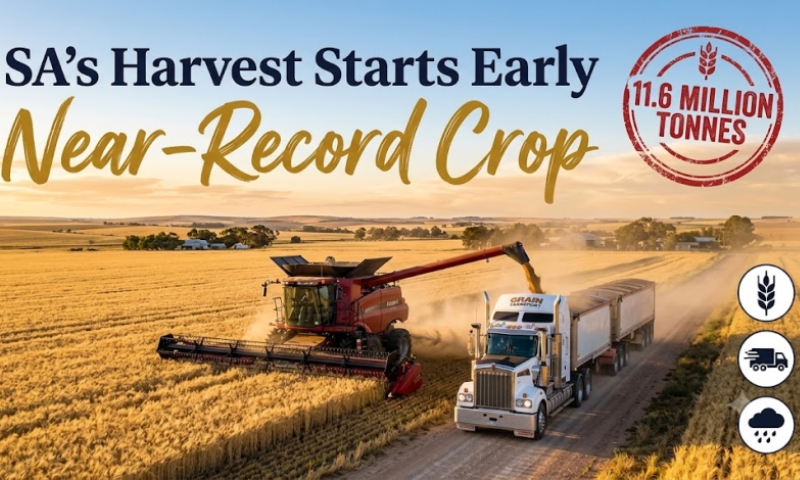
Jesse Chandler didn’t wait for October. On 24 September he rolled into the Thevenard silos, near Ceduna, with a truck full of Commodus barley, and just like that South Australia’s 2026 grain harvest was underway.
Home for the Chandlers is Charra, about halfway along the road from Penong to Ceduna. Jesse works the place with his brother Harlee and their parents, Milton and Tracey. Milton has been on that land since 1980 and he told the ABC he’d never reaped this early. His previous earliest was in 2014 or 2015, when they got going on the Friday before grand final day. This year they beat that by a day.
He also said it’s the best the crop has ever looked. He’s been farming there for over 40 years, so he’s seen a few seasons.
The numbers keep going up
PIRSA has lifted its harvest forecast again. The department now reckons about 11.6 million tonnes will come off roughly 4.2 million hectares this season. Back in July it was saying 9.8 million.
That would put 2026–27 about 32 per cent above the state’s five-year average, and second only to the record 12.79 million tonnes in 2022–23. Of that, wheat is about 6.38 million tonnes. Barley is around 2.63 million.
ABARES, the federal forecaster, landed a touch lower at 11.3 million tonnes. Nobody’s arguing about the big picture, though. It’s a very good year.
It was the rain, mostly
Good autumn rain meant farmers could get crops in early. Milton’s first wheat went in on 8 April. He says he was a bit nervous sowing that early. But they’ve got a lot of heavy country, and when it’s wet you just have to get on with it.
Winter then did the rest. No region missed out. Rainfall was average or above right across SA, and August was the fourth wettest on record.
In most seasons there’s at least one stretch where the crop runs short of moisture. Mr Chandler said that never really happened this time and described the year as close to “textbook”. He’s expecting around four tonnes a hectare off his barley.
Not everything about a wet year is good news. PIRSA says disease has been more of a problem than usual, with rusts, powdery mildew, net blotch, black leg and sclerotinia all turning up in different parts of the state.
A surprise top-up in the Riverland
The weather had turned warm and dry over the past few weeks, so last week’s storms were welcome. Most places got somewhere between 15 and 40mm.
Robin Schaefer, who grows grain at Loxton, thought he might get a couple of millimetres on Friday 2 October. He tipped 17 out of the gauge. A bit of his very early barley is too far gone to benefit, he said, but two-thirds of his crop or more should still get something out of it.
His lentils have bulked up enormously this year. He’s hoping all that growth actually turns into grain, and says there are plenty of pods on them.
Good crop, but what about the money?
So are farmers rolling in cash? Not really.
Grain prices are soft and the input costs have been brutal. Fertiliser hasn’t been cheap, and Mr Chandler said he paid $3.27 a litre for some of his diesel at seeding, which he called a bit of a wake-up call. The hope is that big yields make up for ordinary prices.
Mr Schaefer pointed to another problem. After several drought years, a lot of growers simply couldn’t afford to put down as much fertiliser as a season like this would have rewarded. So results will vary from one farm to the next.
Honestly, it’s surprising. Farmers grow a lot, but still they can’t earn much. They put so much effort and dedication into the crop and then don’t get the returns for their hard work, which is really disappointing to see. The rain this year gave them more grain than the last few seasons. But fertiliser is so expensive, fuel is so expensive, and they still can’t make enough profit out of it.
There’s a wider point here too. Big players are getting bigger, and the small ones are still very small, whatever happens with inflation or prices. A good season should leave some room for the smaller family farms, not just the large operators.
Still, nobody’s complaining too loudly. Mr Chandler knows getting all that grain off the farm won’t be easy. But as he put it, “what a great problem”.
Will it make a difference to you?
Probably not at the checkout. Most of SA’s grain heads overseas, and the wheat in a loaf of bread is a pretty small slice of what you pay for it. Wages, power, packaging and freight make up most of the price, so don’t expect cheaper bread in Adelaide.
Where you’ll notice it is out on the roads. Bunge took the Chandlers’ first load at Thevenard. It planned for this harvest to kick off two or three weeks before usual. It takes on around 1,500 extra workers every harvest, including overseas travellers, and says recent visa changes haven’t caused it any trouble finding staff. If you’re driving through the grain belt over the next couple of months, expect plenty of trucks and the odd header crawling along the road.
A good harvest also tends to help country towns. When farmers have a decent year, the pub, the mechanic and the local hardware store usually feel it too.
Not in the silo yet
There’s still a way to go. A hot, dry finish to spring could knock some yield off later crops, and the state government has flagged locusts and El Niño as things farmers are keeping an eye on. Harvest also runs right into fire season, so growers will be working to the CFS harvest code of practice on hot, windy days.
But after the drought of the past few years, most farmers in the state will take an early start and a big crop over the alternative any day.