
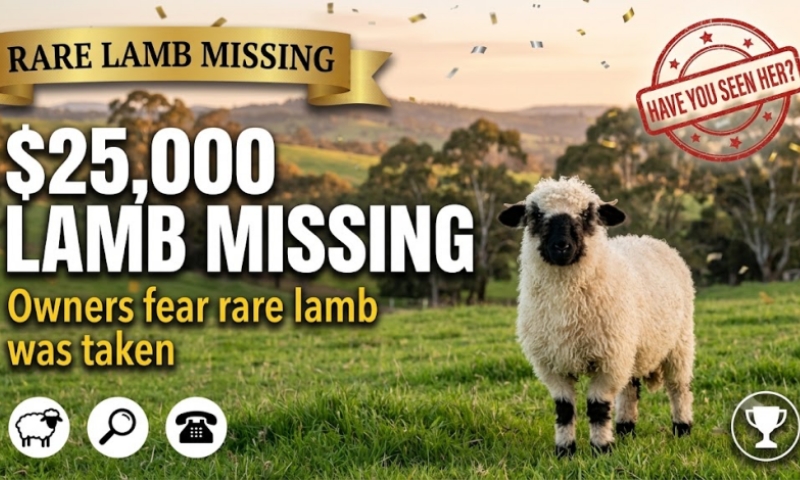
She was only a few days old. White fluff. Black face. Her owners would pick her out of any paddock.
Now she’s gone.
We’re talking about a Valais Blacknose lamb. Value? Up to $25,000. She went missing from an Adelaide Hills property. Her owners, vet Madeleine Babos and her partner Alasdair Rodgers, don’t think a fox got her. They reckon someone took her.
Gone in an afternoon
The ewe lamb was born the week before. Her mum is Sugar, a Valais Blacknose the couple paid $25,000 for.
Babos told the ABC the lamb had been fine several hours earlier. Then, one afternoon, she checked the paddock.
“I realised our initial singleton was gone, which was quite stressful at the time,” she said.
Why they don’t blame a predator
A fox or a dog was the obvious first guess. But a few things didn’t add up.
It happened in the middle of the afternoon. Sugar seemed calm, not like a ewe that had seen an attack. Plus there were other little lambs in that paddock. Nothing touched them.
So Babos has a different theory. She thinks somebody may have taken the lamb to keep as a pet.
Police told her livestock theft is common, she said.
The world’s cutest sheep
If you haven’t seen a Valais Blacknose, look one up. You’ll get it straight away.
They come from the Swiss Alps. Big shaggy white coats, black faces, black ears, black knees and spiral horns. People call them the world’s cutest sheep. Fair enough, too. Breeders reckon they act a bit like dogs. They’ll come up to you for a scratch on the head.
The Swiss have farmed them for meat and wool since the 1400s. But they’re new here. Getting them here was a slog. The import took three and a half years. Semen and embryos finally arrived in 2020. The breed has since spread to Victoria, Tasmania, South Australia and New South Wales.
Priced like a new car
Why so dear? There just aren’t many of them.
A purebred can fetch up to $25,000, The Land reported. First-cross ewes go for $4,000 to $6,000. Wethers range from $500 to $5,000.
Breeding a purebred the slow way takes five generations. Each cross gets closer: 50 per cent, then 75, then 87.5, then 93.75, and finally purebred. The faster option is to buy an embryo and put it into a recipient ewe. Neither is cheap.
So a pure ewe lamb, like the one that went missing, is a big deal. She’s not just one sheep. She’s the start of a flock.
It’s not just about the cash
This flock was meant to be their future. They saw the breeding project as an investment that could pay off in a few years, and a way to get the family back on its feet after a tough stretch.
“Disappointing to have something vanish that’s the next stage in your life that you’ve been working towards,” Rodgers said.
One more thing, if you’re tempted to buy one of these as a pet. Breeders stress they’re livestock, not backyard animals. That wool grows six to eight inches every six months, so they need shearing twice a year.
What to look out for
The lamb is a purebred female. She was only days old when she went missing. Babos says she has “some very distinct markings”.
If you’ve seen a very young black-faced lamb turn up somewhere unexpected in the Adelaide Hills, the couple wants to hear about it.
“Please reach out to us… reach out to police,” Babos said.
Anyone with information can call Crime Stoppers SA on 1800 333 000.
Somewhere out there is a little lamb with a black face who belongs with her mum. Babos and Rodgers just want her back. Fingers crossed someone owns up.