
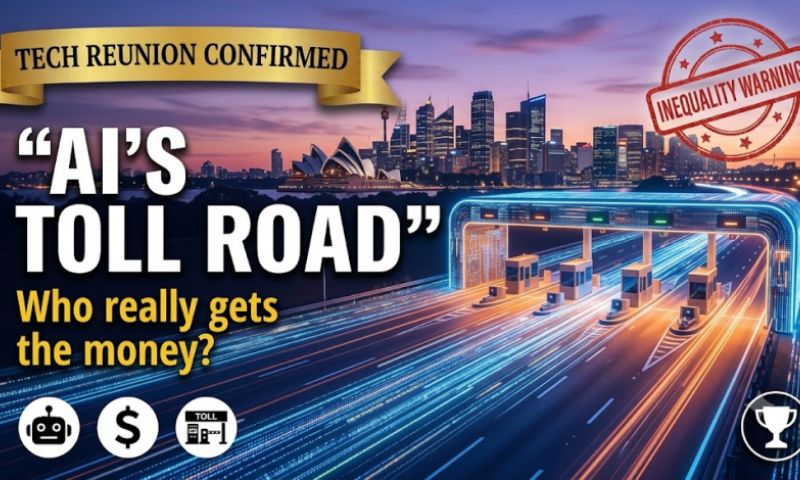
Picture a toll road. Every business in the country has to drive down it. And a handful of AI companies own the booths.
Sounds far-fetched? Not to Labor’s Andrew Leigh. That’s his worry on AI and inequality. He laid it out on Tuesday in a speech to a JPMorgan AI conference.
His warning has a twist, though. Pay gaps between workers could get smaller. And Australia could still end up less equal.
Both can be true
Take a junior accountant. Give them good AI tools and they might work nearly as well as a senior one. So what’s ten years on the job worth then? Less than it used to be.
“AI could narrow the gap between the novice and the expert,” Leigh says.
The catch? It could widen a different gap, he says. The one “between people who earn mainly from their work and people who earn heavily from owning productive capital.”
Put simply, wages might even out. But if the real money goes to whoever owns the tech, the rich still pull ahead.
“Higher returns compound over time,” Leigh told the conference, according to AAP. “So automation widens the gap between the have-nots and the have-lots.”
Enter the toll collectors
Leigh is the assistant minister for competition, among other things. So market power is on his mind.
Imagine half the country’s businesses running on the same two or three AI systems. The companies running them sit in the middle and take a cut of everything.
“If a handful of AI companies become toll collectors for the rest of the economy, overall income inequality could rise,” he says.
Your business gets faster with AI. Great. But if the supplier can jack up its prices, or your rivals copy you in a month, where’s the extra money gone? Not to you.
Leigh’s version is short. “The economic question is the size of the toll.”
What about jobs?
For young workers there’s another worry. Juniors get better with AI, sure. But then a firm might not need as many of them.
The evidence so far is mixed, Leigh says. Young Americans are showing warning signs. Denmark, much less so. And here, entry-level job outcomes “remain solid.”
A government report has also found AI isn’t yet causing broad disruption to Australia’s job market.
Your super might help
There’s one bit of good news in the speech. Plenty of Aussies already own a slice of the tech boom.
“Universal superannuation means that many Australian workers have part of their savings invested in technology firms,” Leigh said, AAP reported. So if tech firms boom, a bit of that lands in your super.
His closing line? “AI will boost productivity. Sharing the benefits fairly is the real challenge.”
MPs want safety checks on AI firms
Leigh wasn’t the only one talking AI in Canberra this week.
A parliamentary committee on AI has sent early advice to Prime Minister Anthony Albanese, the ABC reports. It wants AI companies to face independent safety checks. It also wants independent experts placed inside the big AI labs, with access to their systems.
Security agencies like the Australian Signals Directorate would get early access to new models, as a condition for frontier labs training them here. The committee also wants some computing power set aside for national security and university research.
On copyright, it told the government to “examine” the current rules. Creators should keep control of their work and get paid, it said.
That’s a sore point. Liberal deputy chair Jonno Duniam says copyright holders are currently getting “One hundred per cent of nothing.”
A bit of a row, too
Not everyone’s happy with how the advice came together. Independent senator David Pocock says an adviser to Albanese “pre-vetted” the letter, and that a draft had mark-ups from the PM’s office.
“We’ve seen enough major party stitch ups,” Pocock said.
Labor and the Coalition both deny any interference. “There has been no guidance, no interference,” Duniam said.
And Jo Briskey, who chairs it? Nothing’s locked in for the final report, she says. There’s “more work to do.”
Where to from here
The committee’s final report is due in November. The government is hoping to bring in laws on data centres and frontier
AI standards by the end of the year, and pass them early in 2027.
For most Australians, it comes down to one question. AI makes the pie bigger. Who gets the extra slices? Leigh’s answer, for now, is that it depends who owns the toll booth.