
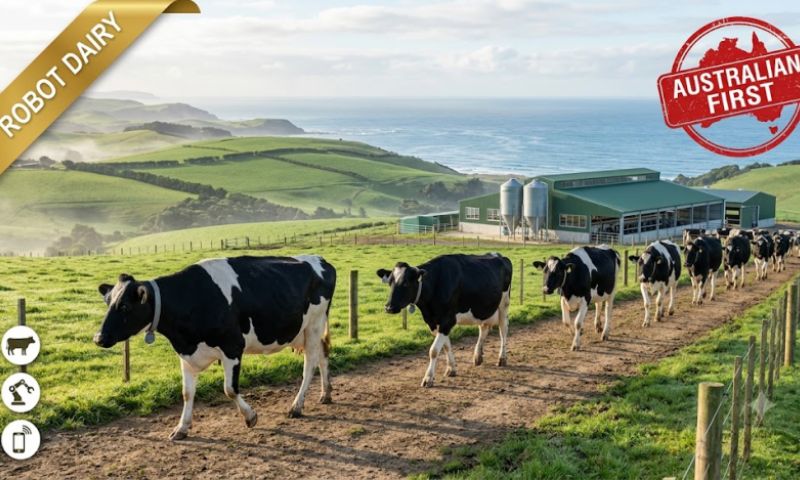
Dairy cows wearing GPS collars walking along a green paddock track towards a modern milking shed on the Tasmanian coast
Simon Badcock can be sitting in a cafe with a coffee. Back on the farm, meanwhile, his cows are walking themselves in for robotic milking.
Sonia’s his wife. Their dairy’s up on Tassie’s north-west coast. Remote bit of the state.
Two years ago they put two bits of tech together. Virtual fencing collars. Robot milkers.
Nobody else in Australia had done both at once. That’s the ABC’s word on it.
Fences you can’t see
Every cow wears a collar. GPS. It tracks where she is and how she’s going.
The brains? Something called a “cow-gorithm”. It’s AI, basically. Vibration, sound and herd behaviour, all used to steer cows between paddock boundaries that aren’t really there.
Cow heads the wrong way? Buzz. Then a sound. Still ignoring it? A low-energy electric pulse.
Simon opens an app on his phone. Sets up a few virtual fences. Cows walk the line. Right to the shed.
Who’s next?
Grain inside the robot. Fresh grass after. The cows know the deal, Sonia said.
The robots never shut. Cow walks in, gate closes behind her. Ear tag. Robot reads it. Knows who’s who.
Milked too recently? No milking for her. She eats and moves on.
Nearly 100 cows a robot
They’re pushing it, Simon admits. Nearly 100 cows per robot.
So downtime’s a problem. Sometimes they head in during the night to sort things out.
“Once a week, maybe,” he said.
Otherwise it’s keeping an eye on things. Checking the herd. Washing down the machines.
“You can look after the rest of the farm better, and you can have time off.”
Does the cow get a say?
Megan Verdon has a few questions. She’s a researcher at the Tasmanian Institute of Agriculture. She’s studied what GPS collars mean for animal welfare.
“Any system has trade-offs,” she said.
Why robots, originally? So a cow could pick her own milking time. Batch them in with collars? Then the cow’s not really choosing.
That might be okay. Nobody’s looked into it yet, she said.
Biggest difference from a normal dairy? No human in the mix. Good or bad, she reckons it could go either way.
Still, it could take some load off. Plenty of dairy farmers are already doing 12-hour-plus days, Dr Verdon said.
Where it’s legal
The collars are approved in every state except Western Australia. They’re still being assessed over there.
Beef’s having a big year in other ways. Rain sent cattle prices into a new gear last month.
As for the Badcocks, they’re still tinkering. It’s “definitely getting better and easier all the time”, Simon said.