
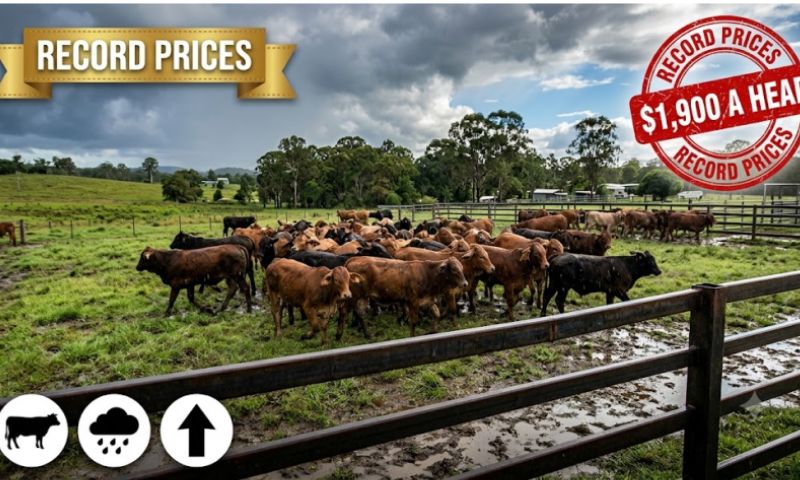
Scott Loughnan had it all planned. Feed the cattle right through summer.
The forecasters were calling a super El Niño. “It was apparently never going to rain again,” he told the ABC.
Then it rained. More than 160 millimetres on his place west of Roma.
And cattle prices went through the roof.
Back above 1,000 cents
Here’s the big number. The Eastern Young Cattle Indicator, or EYCI, jumped back above 1,000 cents a kilo this week, Meat and Livestock Australia says.
Restockers and backgrounders are scrambling for cattle. Paddocks that were brown a few weeks ago are suddenly growing grass.
“The cattle market shifted to a new gear off the back of this rain,” said MLA’s market information manager, Stuart Bull.
There’s a second reason too. Not as many cattle are turning up to sell. Fewer head, more buyers. You can guess the rest.
“Some of these regions were in need of a good drink,” Bull said.
$1,900 a head at Roma
Roma had a big Tuesday.
Weaner steers from the Winton district sold for $7 a kilo. That’s more than $1,900 a head.
Dubbo? Same story. Restocker demand had “sparked a market boom,” it said.
Young cattle sold up to 80 cents a kilo dearer than the week before. The best young steers topped $7.40/kg. Restocker heifers made $6.50/kg.
Records falling
Not just good prices. Record ones.
MLA’s national processor cow indicator went past $4 a kilo. That’s never happened before.
The national heavy steer indicator hit a new high as well, at $4.77/kg.
For producers who’ve copped high farm costs and a dry year, that’s a welcome turn.
Bigger steers, more competition
Simon Quilty is a livestock analyst with Global AgriTrends. He reckons heavy steers are in short supply.
Feedlots used to want steers around 450 to 500 kilos. Now they’re after animals of 550 to 630kg. That puts them head to head with the processors.
“So there’s competition for numbers between the north and the south of Australia, plus processors versus feedlots,” he said.
A herd rebuild is just kicking off, Quilty reckons. In a rebuild, graziers with grass usually keep their heifers to breed. Even fewer cattle for sale, then.
His tip for next year? Heavy steer prices up about 20 per cent, to around $5.70 a kilo.
Not great news for everyone
Rain doesn’t suit every farmer at once.
Loughnan was in the middle of harvesting wheat, barley and chickpeas. For winter crops, he said, the downpour was “not very good.”
But it’ll grow feed. And it sets up moisture for the next planting.
Those summer feeding plans? “This will definitely make it easier,” he said.
Much of Queensland has had rain 10 days straight, the ABC says, and more is on the way. Drought had crept in on both sides of the Queensland-NSW border this year. Farmers there won’t be complaining too loudly.
What about the meat counter?
Will shoppers feel it? Maybe. Cows and steers are fetching record money at the moment.
How much ends up on your weekend snags or Sunday roast is hard to say yet. Retail prices don’t move week to week the way saleyards do.
For now, the winners are pretty clear. They’re the graziers who held on through the dry and now have grass coming up under their feet.
The El Niño forecast hasn’t gone anywhere, mind you. Hot, dry summer? Then this market might cool off fast.