
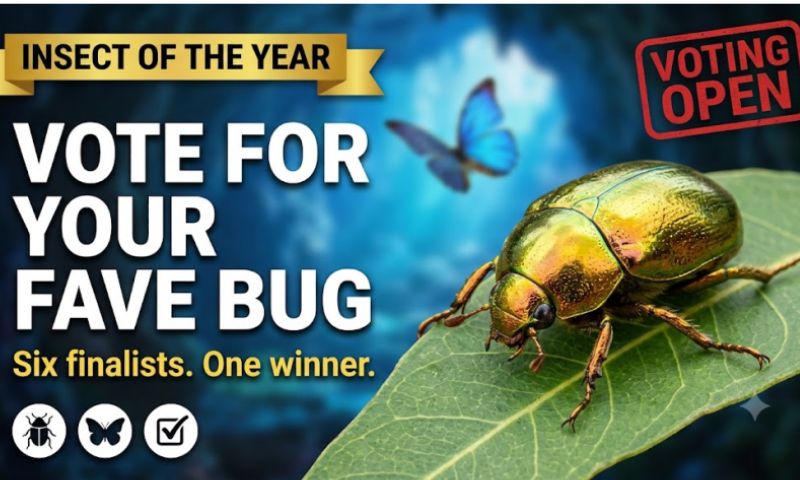
Forget koalas for a minute. This one’s for the bugs.
Voting is open for the 2026 Australian Insect of the Year, the ABC’s yearly popularity contest for creepy-crawlies. Six finalists. One winner. And you get a say.
On the weekend, Aussies picked their favourite book. Now it’s the insects’ turn.
The gold one
First up, the gold Christmas beetle. Shiny. Chunky. Used to crash every summer barbie.
Seen one lately? Probably not. They’re getting rare. Scientists now count them, literally. It’s called the Christmas Beetle Count. Experts including Invertebrates Australia’s Dr Kate Umbers put this one forward.
Two butterflies
The Mallee Bronze Azure is a brown butterfly with bright blue flashes. It’s also critically endangered. Zoos Victoria nominated it, and runs a program to try to save it.
Then there’s the orchard swallowtail. You might know it as the citrus butterfly. It’s one of the biggest butterflies in the country.
Caterpillars on the lemon tree? Plenty of gardeners freak out. Don’t, says Gardening Australia magazine’s AB Bishop, who nominated it. They rarely do lasting damage. And the adults are handy pollinators.
A glow-worm that isn’t a worm
The Otway glow-worm is a bit of a fibber. It’s not a worm at all.
It’s actually the larva of a fungus gnat. And it glows to lure in dinner. You’ll only find it in south-west Victoria, and it doesn’t cope well when its home gets disturbed. Its backer? Mark Schutze, Australian Entomological Society.
Eyes on stalks
Now for the weird one. Our pick for most likely to turn heads.
The stalk-eyed signal fly lives in north Queensland. It’s the biggest stalk-eyed fly in Australia. Its eyes sit out on long stalks, which help it impress mates and see off rivals.
What does it eat? Rotting fruit. And animal poo. Lovely.
CSIRO entomologist Keith Bayless nominated it. CSIRO is campaigning, too. “Vote now for our weird little fly,” it posted.
Tiny but tough<
Last, the tortoise-shelled ladybird. It’s only about 6 millimetres long.
Don’t let the size fool you. Adults and larvae both chow down on soft-bodied pests like aphids. Nature writer and photographer Peter Rowland nominated it.
Who won before?
The blue-banded bee took out the first title in 2024. 2025? A dragonfly. The graphic flutterer, to be exact.
So a bee, then a dragonfly. Will a fly with a poo diet make it three different winners in a row? We’ll see.
How to vote
Head to the ABC’s Insect of the Year page and pick your favourite. Voting closes at the end of October.
Results drop on 9 November. That’s day one of Australian Pollinator Week.
Why bother?
It’s a bit of fun, sure. But insects do a lot of heavy lifting. They pollinate crops, clean up waste
and feed birds, frogs and lizards.
And a few of these finalists are in real trouble. A bit of attention can’t hurt.
So which one’s getting your vote?