
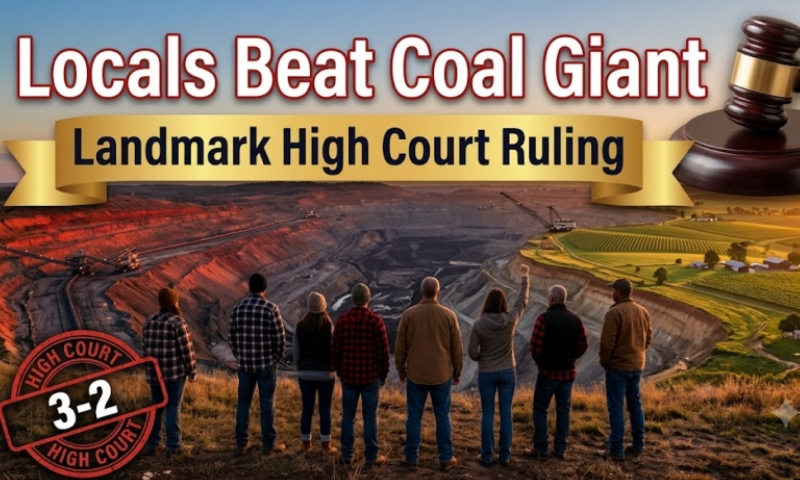
Wendy Wales and her neighbours spent four years fighting a coal mine expansion near Muswellbrook. They took it through three levels of court. This week, they won.
The group goes by DAMS HEG, short for Denman Aberdeen Muswellbrook Scone Healthy Environment Group. The High Court sided with them 3-2. The case was over the expansion of MACH Energy’s Mount Pleasant open-cut coal mine in the Hunter Valley.
No climate case had ever made it to the High Court before. Lawyers think it could shake up how coal and gas projects get approved, and not just in NSW.
What the case was about
In 2022 the NSW Independent Planning Commission signed off on a big expansion. MACH wants 444 million tonnes out of the ground by 2048. That’s close to double its current yearly output.
The locals said the commission missed something big. When that coal is burned overseas, it will release more than 870 million tonnes of carbon dioxide equivalent. They’re called Scope 3 emissions. The group argued their impact on the local climate should have been weighed up.
The NSW Court of Appeal agreed with them unanimously. MACH took it to the High Court and lost.
What the judges said
Three of the five judges found planning authorities must “consider imposing conditions to minimise to the greatest extent practicable all greenhouse gas emissions, including Scope 3 emissions”.
Put simply, you can’t just look at the hole in the ground. Where the coal gets burned counts too. Even if it’s shipped halfway round the world.
So the expansion approval is dead in the water for now, the Newcastle Herald reports. It has to go back to the NSW Land and Environment Court or the planning commission to be assessed again.
What the locals said
Ms Wales, who leads the group, didn’t mince words. “We cannot dig up coal, ship it overseas, watch it drive climate change, and then pretend the consequences have nothing to do with us,” she said.
Treasurer Tony Lonergan was a bit more measured. “This isn’t the end of coal overnight. But it is the end of coal mine approvals that look the other way on climate.”
Their lawyer, Anita O’Hart of Johnson Legal, put it in legal terms. Authorities, she said, “cannot ignore the chain of causation from a project’s emissions”.
A handful of locals from the Upper Hunter, up against a mining company, at the top court in the land. And they won. Whatever you think of coal, that’s a big deal.
What MACH Energy says
MACH Energy said it acknowledged the decision and would “work constructively with regulators, governments, local communities and other stakeholders”.
A MACH spokesman also said the mine’s roughly 500 full-time workers had lived with fear and uncertainty for too long.
To be clear, the mine isn’t closing. Back in August, NSW gave it the nod to keep digging till the end of 2032. That approval also lifted its output from 10.5 to 12.5 million tonnes a year. It’s the longer expansion out to 2048, which would add 22 years to the mine’s life, that is now back in doubt.
Politicians and miners react
Greens MP Sue Higginson said the court had “exposed the New South Wales coal approval process for the sham it is”.
The Minerals Council of Australia saw it very differently. Chief executive Tania Constable called it a “further blow” and blamed “lawfare by activists”. Her worry? Mines “may have to work out how to reduce emissions from their export customers”.
Murray Watt, the federal environment minister, played it down. He called it a “novel decision” and said federal approvals weren’t automatically caught up in it.
Over in Macquarie Street, NSW Natural Resources Minister Courtney Houssos made a similar point. In her words, it “does not mean the expansion cannot be reconsidered or that coal mine extensions cannot be approved”.
Why it matters beyond the Hunter
This goes a long way past Muswellbrook. There are 17 coal proposals sitting in the NSW planning system right now, per the Newcastle Herald. Any of them could feel this. Other states are likely to follow the ruling as well.
Coal and gas approvals could now drag on longer, with tougher emissions rules attached. Mining towns will be asking what that means for jobs. Meanwhile, if you live next to a mine, you’ve now got a fresh argument up your sleeve.
Where to from here
The expansion now goes back to be assessed again, export emissions and all. Miners, governments and green groups will all be watching how that plays out.
The Hunter was built on coal. This ruling won’t change that overnight. But the question of what comes next just got a lot harder to ignore.