
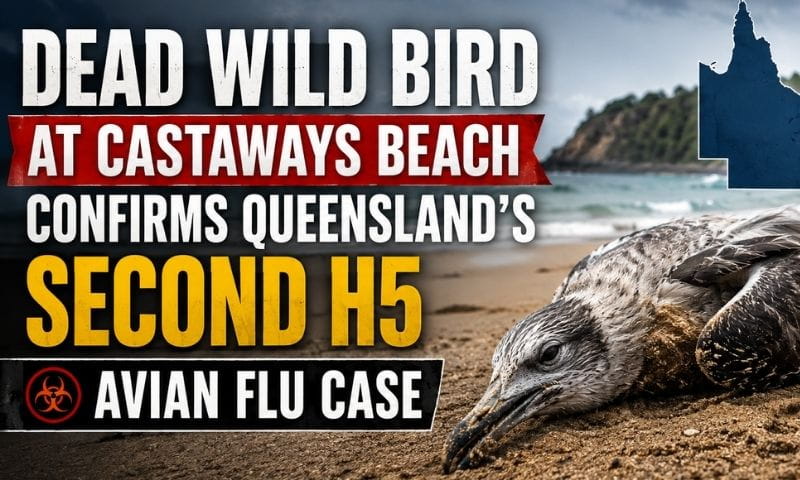
A single dead seabird, found tangled in the tide line of a quiet Sunshine on Castaways Beach, has become the latest marker of how far the H5 avian flu outbreak has crept up Australia’s east coast. Queensland authorities confirmed this week that a wild shearwater picked up at Castaways Beach has tested positive, making it the state’s second detection since the virus first arrived in late July.
Second Detection Puts Queensland on Alert
The finding follows Queensland’s first case, a dead petrel discovered on Morton Island several weeks earlier. That the virus has now turned up on a populated stretch of coastline, rather than a remote island, has sharpened attention on how quickly H5 avian flu is moving through the state’s migratory bird populations. The Department of Primary Industries says there is still no sign of the disease in commercial poultry and no evidence of mass wildlife deaths, but officials are treating the detection as a signal that the risk is no longer theoretical.
Samples from the shearwater returned a positive result at the state government’s insecurity laboratory before being sent to the CSIRO’s national disease preparedness centre for confirmatory testing, the standard next step whenever a new case is picked up. Chief Veterinary Officer Dr Allison Crook said the bird was found through Queensland’s enhanced surveillance program, which relies heavily on members of the public spotting and reporting dead wild birds.
On Castaways Beach, a Shearwater’s Discovery was made
Castaways Beach is located just south of Noosa Heads, a beautiful location surrounded by national park and beloved by walkers, surfers and birdwatchers. This is precisely the sort of place a migratory sea fowl may wash ashore hours unnoticed and precisely the sort of location where folks are now told to look twice prior to approaching one. As shearwaters migrate vast distances annually from their breeding grounds in the Southern hemisphere, crossing the Pacific Ocean, they are one of the highest risk of spreading the virus to new areas during flight.
The finding at Castaways Beach demonstrates the success of the state’s passive surveillance strategy-instead of actively looking for infected birds, the state relies on prompt public reporting to detect cases early, Dr Crook said. She said a member of the public spotted this dead bird, and reported it immediately, which has helped keep the response quick.
What It Means for the Sunshine Coast
For residents along the Sunshine Coast, the case is a reminder that the region’s beaches sit directly on major seabird migration routes. Local business and community groups have been watching the virus’s southern march for months, aware that dead wild birds washing ashore could eventually affect everything from backyard chicken keepers to the region’s tourism-dependent beaches. So far, though, officials stress there is nothing close to the scale of bird deaths recorded interstate.
Elsewhere in the country, the picture has been considerably grimmer. South Australia has recorded at least three mass mortality events among wild birds, along with the nation’s first confirmed detection of the virus in a marine mammal. Detections have now been logged in most Australian states, underscoring how comprehensively the virus has spread since it first reached the country’s shores earlier this year.
Authorities Weigh Mass Bird Death Risk
Deputy Director-General and Chief Biosecurity Officer Rachel Chay said Queensland remains a comparatively low-risk state for now, but cautioned that could change as migratory seasons continue in the years ahead. “We do have to be prepared that… we may see mass events here,” she said, pointing to the pattern already playing out further south.
Authorities are trying to find vulnerable native bird species that could be candidates for vaccination, but the process is still not an easy one, Chay said. However, the vaccine needs to be given twice and would have to be kept in captivity, or recaptured a few weeks later, for the booster dose, making its application more broadly impractical.
Vigilance: Best Defence for Now
Primary Industries Minister Tony Perrett has told state parliament that shielding the state’s sizeable poultry industry remains the government’s central priority as the virus continues to circulate among dead wild birds and other wildlife. An Incident Management Team is now coordinating the response to the latest case, with heightened surveillance and regular public updates planned in the weeks ahead.
For now, the message from health and bio security officials is one of calm but sustained vigilance rather than alarm. The state’s enhanced monitoring program depends on exactly the kind of chance discovery that led to the Castaways Beach detection, and authorities say that pattern is likely to repeat as more infected birds complete their seasonal migrations along the coast. Whether the state can keep pace with a virus already reshaping wildlife elsewhere in Australia may depend on how well that early-warning system holds up in the months to come.