
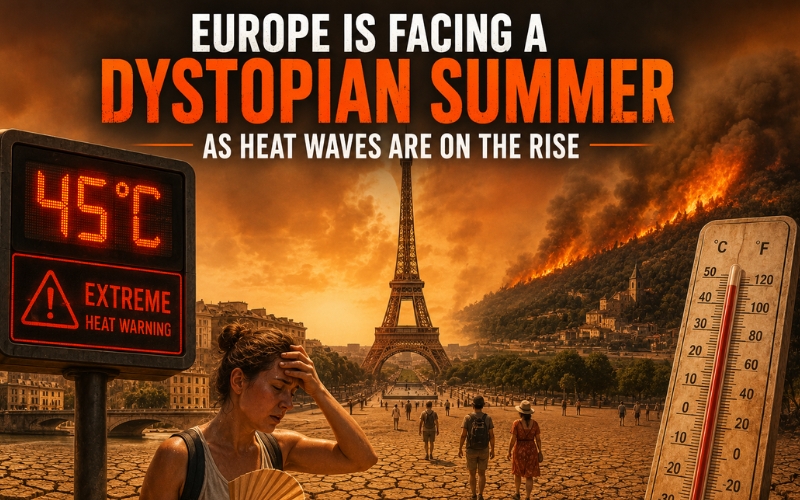
It’s disturbing to see a quiet summer morning become perilous before noon. It’s a growing reality in Western Europe. The tourist-filled streets are now deserted during the heat of the day.
Europe has been at a new reality for a number of years now, and scientists have been warning about extreme weather for years. What used to be a “once in a blue moon” situation is starting to seem like the norm. Communities are no longer facing warm weather—they are facing increased heat waves that are straining infrastructure, agriculture, and public health. Executive Secretary of the UN Climate Change Secretariat Simon Stiell told governments in a recent climate change briefing to speed up substantive action rather than lip service.
Temperature Records Broken
Another series of remarkable readings has been enjoyed this summer in several countries.
Throughout France, heat warnings were issued across the board where temperatures were reaching critical levels. In Spain, weather stations reported values which broke and/or exceeded previous seasonal records and in a few areas, outdoor activities were limited during the hottest hours of the day.
Over there, fire spread fast in Greece, causing evacuations and adding to the already stressed emergency services in the face of the intense heat. The smoke billowed from large areas was a reminder that record temperatures come with cascading impacts to local economies, ecosystems and public safety.
The isolated record is no longer the primary focus, according to meteorologists. Instead, it is the regularity in which new extremes are being set that worries climate researchers most. Few summers are remembered for the warm weather that occurred, but it is now replaced only a few years later with even warmer summers.
Why Europe is the furnace of the globe
Europe is becoming one of the warmest continents in the world, as climate scientists have been stating, and the evidence continues to back up that fact. Changing atmospheric circulation, big reduction in snow cover over the mountain regions, and warming of the Mediterranean Sea has led to the increasing occurrence of prolonged high temperatures.
European ecosystems, infrastructure and public services were built for milder summers, while they are not built to withstand the warm summers of tropics.
So, a few extra degrees of warming can have repercussions that are far reaching. Crops are ready for harvest too early, rivers run low, and electricity demand increases dramatically as cooling systems are forced to run around the clock.
The changing climate has also sparked a comparison with Australia, which has long experience of coping with extreme summer conditions. Australia has spent a considerable amount of money preparing for the heat, but many European cities are still coming to terms with conditions that were unimaginable just a few decades ago.
Climate researcher Allie Gallant says these repeated extremes shouldn’t be considered just a few weather events, but signs of a climate system that is slowly changing. Her findings align with the global scientific evidence of increased frequency and severity of extreme heat, which is a result of the warming climate. Her observations support the general scientific findings that extreme heat is becoming more frequent and severe throughout the world, a result of the warming climate.
Beyond the Thermometer: The Cost of Extreme Heat
The effects are far-reaching and go beyond uncomfortable afternoons.
Argentina is seeing a continuation of below-average yields caused by the lack of rainfall, with farmers in Western Europe saying this is affecting their crops as well, especially their vineyards, wheat farms and fruit orchards. One of the top industries in the region is also taking a hit, tourism. Tourists traditionally flocked to these historic cities in July and August but now have a wider choice of places with lower temperatures or travelling at off-peak times.
Healthcare services have been increasingly on the brink of dehydration, respiratory illness and heat exhaustion. During prolonged hot weather, older adults and individuals with chronic health problems continue to be at high risk.
This is a Summer That Demands Action
The heat waves that we had all year long have once again shown the difficulties of Europe. The continent is facing a future predicted years ago by many scientists as France responds to an emergency, Spain is setting new records, and Greece faces devastating fires.
The response of European governments will decide how future generations will experience the summer. The response has to be now, whether it is urban planning, increased investment in environment protection or change in the fundamental policies; it has to be fast and precise. Severity of western Europe’s climate change is a bitter reality and the society will have to adapt to it, while they are living their lives.