
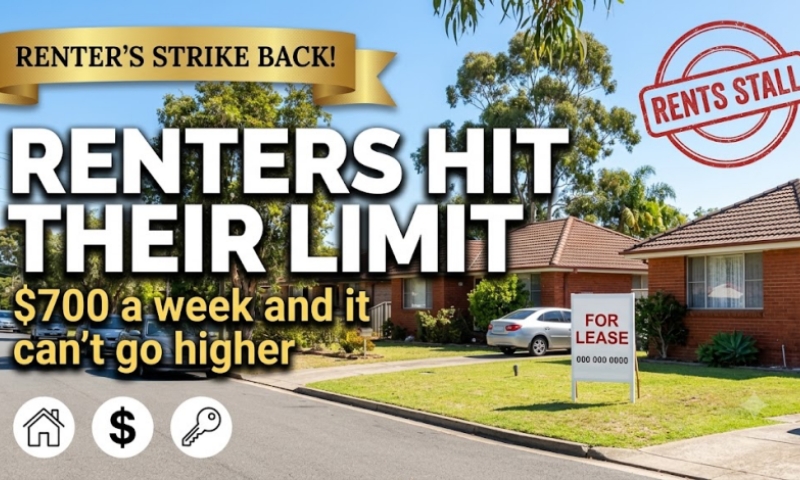
Seven hundred dollars a week. That’s the going rate for a house in our capital cities. And for the first time in a long while, that number didn’t go up.
Not because rentals are suddenly easy to find. It’s because tenants have simply run out of room to pay more.
What the numbers say
New Domain data for the September quarter shows capital city house rents flat at $700 a week. Unit rents still nudged up 1.5 per cent.
Rents barely moved in Melbourne, Brisbane, Perth or Adelaide over the three months. Sydney house rents actually slipped $5, to $835 a week. In Canberra they fell $10, to $700.
Two cities bucked it. Darwin house rents jumped 5.3 per cent to a record $800. Hobart rose 1 per cent to a record $625, and Hobart units hit a record $525.
Sydney, Darwin and Perth remain the priciest places to rent a house.
Plenty of demand, no more money
Here’s the strange bit. There still aren’t many rentals going.
The national vacancy rate edged up just 0.1 of a percentage point, to 1 per cent. That’s still tighter than it was a year ago. Normally, a market that tight pushes rents higher.
Domain’s chief residential economist, Dr Nicola Powell, called it “a disconnect”. Normally, she said, “low supply has consistently pushed rents higher”. Not this time. Now tenants just can’t stretch any further, and that’s what’s holding growth back.
Make no mistake, though. Landlords still hold the cards, though. Powell calls it “a landlords’ market” across every major capital and regional area. Most of the rent rises this year landed earlier on. House rents are still at or near record highs.
Making do
So what are renters doing? Getting creative, according to property economist Cameron Kusher.
Some are moving further out to save money. Others are going into share houses. Plenty of adult kids are simply staying at home with Mum and Dad for longer.
None of those are what you’d call choices people make when things are going well.
The politics of rent
Rents are becoming an election-style fight, too. One Nation has released modelling claiming its migration plan could save renters almost $3,000 a year. It wants to cut 750,000 temporary visas over three years, and says that would bring rental inflation down by 6.5 per cent.
Kusher isn’t convinced. Would it fix affordability? He doubts it. Still, he says renters would take any relief going.
Then there’s the budget. Changes made investing in property less appealing. Some feared rents would spike as a result. So far? They haven’t. Kusher says those changes are still working through.
What it means if you’re renting
A flat quarter won’t make your rent cheaper. But it might give you a bit more leverage.
If your lease is up for renewal, check what similar places nearby are actually going for before you sign off on an increase. With growth stalling in most capitals, a landlord may be keener to keep a reliable tenant than risk an empty property.
If you’re looking, widen the search a few suburbs further out. That’s exactly what plenty of other renters are doing.
Where to from here
Vacancies are still very low, so nobody’s predicting rents will fall in a hurry. The big question is whether the pause holds, or whether rents start climbing again.
For now, the message from the data is pretty clear. Australian rents haven’t stopped rising because things got better. They’ve stopped because renters have nothing left to give.