
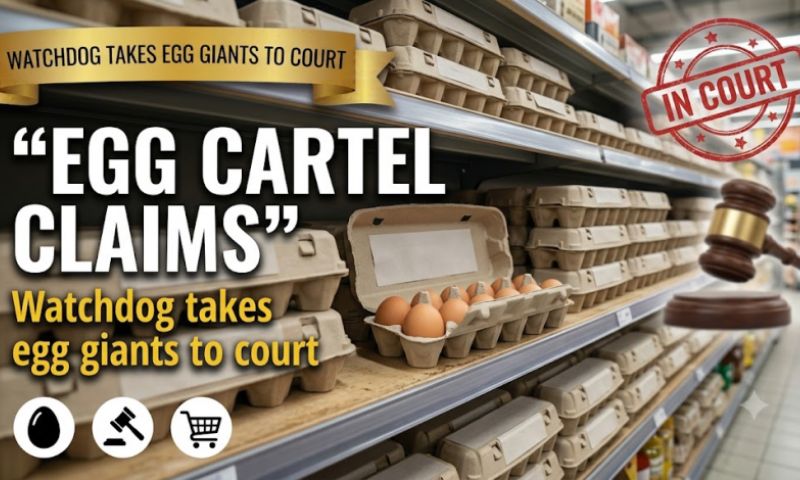
Australians eat more than 250 eggs each a year, on average. That’s a lot of omelettes. And according to the competition watchdog, some of the companies supplying them weren’t really competing.
The ACCC has taken Sunny Queen, the country’s biggest wholesale egg supplier, to the Federal Court. Eleven other producers and suppliers have been named too.
The allegation is “cartel conduct”. Put simply, the ACCC says these businesses were working together when they should have been fighting for customers.
Sunny Queen denies all of it.
Who’s involved
Sunny Queen supplies about a third of the eggs sold to retailers like Woolworths, Coles, Metcash, Aldi and Costco.
Other businesses named include Doug Hall Poultry, McLean Farms (Alpair Pty Ltd), Ellerslie Free Range Farms and Kinross Farm. Seven more companies are also part of the case.
The ACCC says the alleged conduct goes back to at least October 2020.
What the ACCC is alleging
The watchdog claims competitors swapped information regularly. It says they coordinated on how many eggs to produce, where they went, expansion plans and culling. The aim, it alleges, was to manage what they saw as oversupply.
Less supply, of course, tends to mean less pressure on prices to fall.
There’s more. The ACCC alleges some of the companies bought a property in Pittsworth, Queensland, to stop a rival supplier getting its hands on it. It names Sunny Queen, Doug Hall and McLean Farms as involved.
It also alleges Sunny Queen limited how many eggs rival Kinross could sell, and stopped Kinross supplying Coles, Woolworths, Aldi, Metcash and Costco directly.
“Extremely serious”
ACCC chair Gina Cass-Gottlieb didn’t mince words. “This alleged conduct is extremely serious,” she said.
Why should you care at the checkout? She spelled it out on the ABC’s Victorian Country Hour. When there’s good competition, you get more choice and businesses compete on price. That means lower prices.
When competitors stop competing and start working together, she said, consumers “can ultimately miss out”.
How long has this gone on? Years, the ACCC reckons. Competition, it says, was likely “substantially reduced” for “many years”. It also says the egg industry is highly concentrated, and hard for new players to break into.
A first for the ACCC
This case breaks new ground. It’s the first time the ACCC has run a case alleging “concerted practice” since that rule came into force in 2017.
What’s a concerted practice? It’s a step short of a formal deal. Competitors don’t need a signed agreement or a handshake. If they coordinate in ways that cut competition, that can still break the law.
So the outcome will be watched closely, well beyond the egg aisle.
It’s not the first time the watchdog has gone after food suppliers, either. Remember the veggie case? That was September 2025. Some big veggie growers ended up in court over alleged price-fixing on produce for Aldi.
What Sunny Queen says
Sunny Queen isn’t backing down. A spokesperson said the company “has cooperated fully with the ACCC” and “intends to defend the proceedings.”
The company says the allegations relate to agreements it has with its shareholders and main egg suppliers in Queensland and Victoria. It’s “business as usual” in the meantime.
The ABC contacted Doug Hall Poultry, McLean Farms, Kinross Farm, Yallamundi Farms and Ellerslie for comment.
What it means for your shopping
Nothing changes at the supermarket just yet. It’s all allegations for now. Nothing’s been proven. The Federal Court gets to decide.
The ACCC hasn’t said what penalties it’s after. Cases like this can also take a long time.
Still, eggs are in most trolleys every week. If the court sides with the ACCC, that’s huge. And if it doesn’t, the concerted practice rule could end up looking a lot weaker than the ACCC hoped.