
Introduction
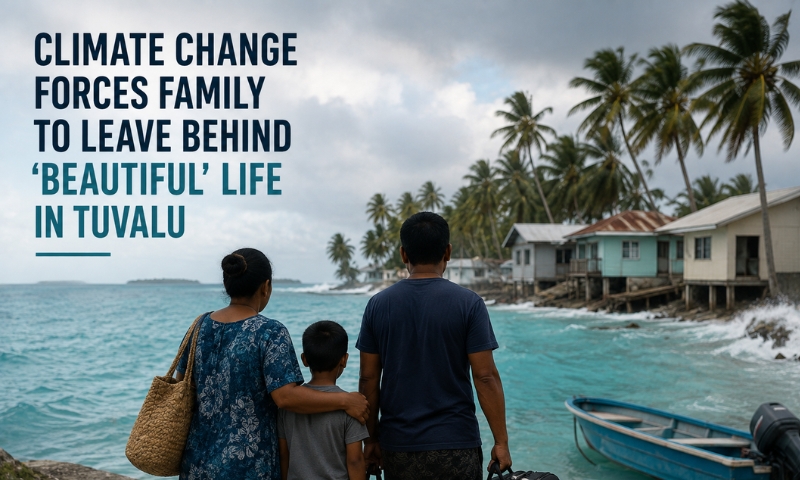
Climate change has become a reality for the people of Tuvalu and is no longer a distant environmental threat. One of the islands of the Pacific Ocean, with its history of native traditions and small communities, is at risk for an uncertain future as sea levels rise, threatening its land, homes and lifestyle.
Tuvalu’s climate change impacts are disastrous. Families are compelled to relocate, livelihoods are changing and cultural identity is at stake. Meanwhile, the government is making efforts to safeguard its citizens by developing a Tuvalu Climate Change policy forward-looking and based on local adaptation and international cooperation.
Why Tuvalu is vulnerable to climate change
The country has a population a population of 11,000, and the people are living only few meters above the sea level. Tuvalu comprises 9 coral islands which are 4000 km northeast of Australia in the pacific.
Tuvalu’s geographic location plays a huge part for it to be at risk of sea level rise. Small rises in sea-level alone can cause houses to flood, freshwater sources to become polluted, farms to be ruined and coastal erosion to be enhanced. In contrast to larger countries Tuvalu has very little land within its own geographic boundaries to move people to.
How climate change is impacting the daily lives of the people of Tuvalu
A community’s physical assets are vulnerable. A major Tuvalu Climate Change Impacts is the rising number of coastal flooding events. The region is frequently hit by high tides, high waves, and severe storms, causing homes and public buildings to be flooded.
Coastal erosion is a new problem caused by climate change. Each year, stretches of shoreline erode into the water, further shrinking remaining shoreline space for housing and community development.
Agriculture & Food Security
Climate change has also had a significant impact on agriculture. Soil has been impacted by saltwater intrusion and traditional crops are becoming more difficult to grow. Previously local farming was the main source of food for many families, but now they are increasingly depending on imported food, which is more expensive and affects their food security.
Freshwater resources are also compromised due to intrusion of seawater into underground water reservoirs during high tide and storm.
Migration: Going away from home for protection
Adjusting to a new country can a bit cumbersome for many people. And the uncertainty about what will happen to the homeland that they perhaps won’t be able to go back to forever.
Migration is thus one of the most profound social impacts of Climate Change in Tuvalu that will impact individuals and communities alike.
The Tuvalu Climate Change Policy
Building Climate Resilience
The Tuvalu Climate Change policy is about helping communities to adapt to environmental change, not merely react in the aftermath.
Government initiatives include:
- Building sea-defences
- Taking up and restoring land heights in low-lying areas.
- Enabling better water management systems.
- Strengthening disaster preparedness.
International Cooperation
Tuvalu understands that climate change is not something that can be addressed alone, and actively pursues international partnerships.
A historic deal with Australia has enabled some financial support for climate adaptation efforts and has also created migration pathways for those who are qualified to participate in the scheme. These plans provide alternatives for individuals when circumstances become more challenging.
The Tuvalu Climate Change policy is a good example of the way vulnerable countries are preparing their own plans while taking an active role in international collaboration to reduce one of the world’s most serious environmental issues.
Why Tuvalu Matters to the World
This nation’s problem is a stark reminder that climate change is not just a environmental problem but it is an humanitarian one as well. Also, it’s a bit ironical that a country with one of the lowest carbon footprint has to face such a problem.
Tuvalu’s climate change impacts not just housing or food security but economic and educational stability as well. As sea level continues to rise, the threats that Tuvalu confronts today can grow more likely to be a reality for many other coastal communities worldwide.
Conclusion
The ongoing Tuvalu Climate Change Impacts reveal the profound consequences that climate change can have on both people and nations. Environmental change is impacting every facet of life in Tuvalu – from coastal flooding, to lost farmland, through migration and cultural preservation.
The nation has taken steps to proactively adapt to climate change through its policy on Tuvalu Climate Change, to build international relationships and to make space for future generations. But local action is not going to be a solution to a global problem.