
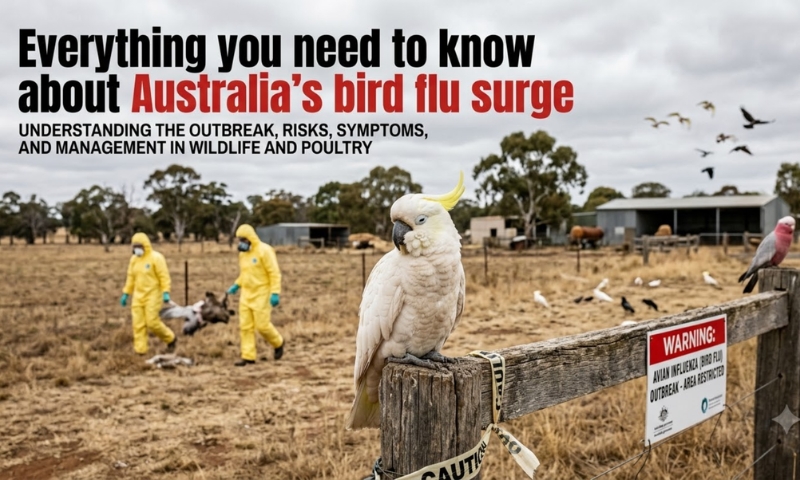
Australia held out longer than anywhere else on Earth. While H5N1 tore through poultry farms, wild colonies and even dairy herds on every other continent since 2021, this country stayed clear – until June this year. Since then, the numbers have climbed fast, and what started as a handful of detections in Western Australia has turned into a genuine national response spanning five states.
As of the most recent update from the Department of Agriculture, more than 230 wild birds have now tested positive nationally. Health and wildlife authorities say that figure will keep rising, and the real question isn’t whether H5N1 keeps spreading – it’s how much damage it does on the way.
How Fast Is Bird Flu Actually Moving?
The pace of the outbreak is surprising even the scientists monitoring it. The number of wild birds detected in the first week of August alone nearly quadrupled, from about 28 to over 100 wild-bird detections in just a few days. So far, it has impacted South Australia the hardest, and dozens of infected silver gulls and greater crested terns have been found along the Limestone Coast and on Kangaroo Island.
But this is no longer a single-state problem – Victoria, Western Australia, Tasmania and New South Wales have all recorded cases too.
New South Wales entered the picture in July, when a giant petrel found near Hawks Nest tested positive. Since then, further detections have followed near Narooma and Wentworth, and authorities there say increased surveillance is now underway along the coast. So far there’s no sign of H5N1 in commercial poultry flocks anywhere in the state, which matters given it produces a large share of the nation’s chicken meat and eggs.
The First Mass Die-Off – and What It Signals
Early in August, testing confirmed what wildlife groups had been dreading: the first mass mortality event linked to bird flu on Australian soil, at Baudin Rocks off the South Australian coast. Dozens of dead and sick greater crested terns were found there, on top of a similar cluster near Cape Jaffa, where helicopter surveillance teams located 49 dead and 35 sick birds.
Environment Minister Murray Watt has warned there will likely be more mortality events like this before the outbreak is contained. He’s flagged particular concern for marine mammals – seals, sea lions and dolphins – all of which sit in high-risk categories. That worry isn’t hypothetical. More than 16000 elephant seals have Died from H5N1 bird flu on Heard Island, which is a sub Antarctic island owned by Australia. It is being considered as mass mortality event.
Why Some Species Face Such High Risk
Nearly 2000 mammal and native bird species have been affected by this new strain bird flu. And over 400 of them are now either in high risk or in extreme risk category. Seabird ecologist Simon Gorta, based at the University of New South Wales, says the concern isn’t just H5N1 itself but what it adds to species that are already under pressure from habitat loss and other threats.
Layering a fast-moving disease on top of that, he argues, is a serious conservation problem in its own right – not simply a wildlife inconvenience.
What’s Actually Being done
A national framework on poultry bio security has been in place since the end of July, with state and territory governments responsible for surveillance and issuing local advice while the federal agriculture department coordinates the overall response. So far, there have been no confirmed cases of bird flu in Australian poultry or livestock – every detection to date has been in wild birds.
Vets and public health experts are leaning heavily on everyday people to help catch new cases early. As one university expert has put it, ordinary citizens are effectively acting as extra eyes on the ground, since most infected birds are found not by official patrols but by members of the public stumbling across sick or dead animals.
If you see a sick or dead bird,
The same advice is given in all states: avoid approaching any bird that appears sick, or dead birds should be avoided, even if approached by pets. If you have located it, document its location precisely, take photographs if possible and report the occurrence at your state’s emergency animal disease hotline not by handling the animal.
Will People Be Concerned for Their Own Health?
At this time, the risk to the public is low, according to the health authorities. No human cases have been confirmed with this wave in Australia and eggs and poultry are safe to eat if cooked properly. At this time, at least, the blame for the outbreak falls firmly on wild animals-and on an outbreak that doesn’t appear to be abating before it makes its way across the country.