
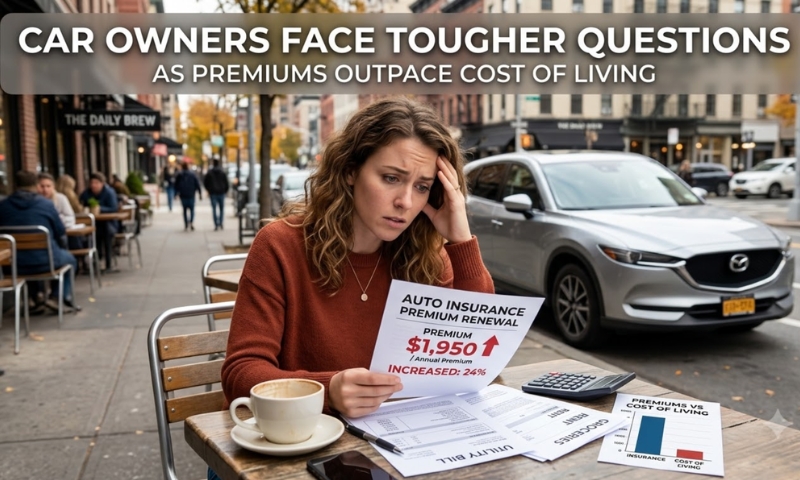
Millions of Australian drivers are being told to pay high premiums on their car insurance that are way above country’s inflation rate. Eight major and well known brands controlled by five major car insurers in the country have communicated the rise in premiums, says ASIC. Customers have been filing complaints across the country because these companies own around three quarters of the car insurance market.
The thing caught the eye of ASIC when they uncovered a pattern of sharp jump in the premiums, and there were no concrete reasons given for it.
Numbers That Tell Their Own Story
During the same period, motor vehicle cover increased by approximately 8 per cent, which is slightly above the general inflation for the same period of time. When zoomed out again, this is even more dramatic — the cost has increased by over 42 per cent during 2019–24. The continuous rise is difficult to bear silently, especially in households already constrained by rents, food and petrol costs, and is evident in the number of complaints which are made to relevant services.
Car insurance was, in fact, the single most complained-about type of cover in the last financial year, and pricing was the leading gripe among those who spoke up. An ASIC commissioner noted that the scale of the increases, sitting well clear of inflation, is a genuine source of frustration for households already juggling cost-of-living pressure, and that customers simply want a clearer explanation of what is driving their bill higher.
Where the Explanations Fall Short for high Premiums
The review’s central complaint isn’t that prices went up — insurers are free to set premium levels as they see fit, and ASIC has no power to cap them. The issue is transparency. Renewal notices from the five insurers examined failed to properly justify why costs were rising faster than inflation, leaving everyday drivers guessing. Many notices also buried the fact that paying weekly, fortnightly or monthly attracts a surcharge of ten to twenty per cent compared with paying the full year upfront — a detail that could save a household real money if it were made obvious.
There’s also a quieter finding buried in the data: loyalty rarely pays off. Around two-thirds of customers simply renewed without shopping around or ringing to query their premiums, often assuming a call wouldn’t make a difference. Yet nearly a third of people who did push back ended up securing a better price. In other words, staying silent and staying loyal tends to cost more, not less, over time.
A Pattern of Legal Action
This isn’t ASIC’s first brush with the sector. It is currently pursuing one IAG-owned brand through the Federal Court, alleging that customers received misleading comparison figures on renewal documents for more than five years despite raising concerns. That same insurer was fined $10 million back in 2023 over separate claims about misleading discount promises, making this the second Federal Court action against the company in recent years. ASIC has signalled it will keep pursuing insurers that mislead customers about pricing or discounts, regardless of how those figures compare with inflation trends.
Industry and Government Respond
The Car insurance sector’s response to the corporate scrutiny has been mixed, and the report lands alongside broader moves to tighten the rules. Canberra is drafting legislation that would force standard definitions into renewal notices, while the sector’s peak body is developing an enforceable code of conduct — a first for the industry. In response to the review, the peak body said it is looking at ways to make premium increases easier for everyday customers to understand and is keen to work with government on the issue.
Individual insurers offered mixed responses. Several deferred entirely to the industry association’s statement, while one brand pointed to rising repair costs, parts shortages, supply chain strain and extreme weather as reasons behind higher premiums, adding that customers unhappy with their bill are encouraged to get in touch to review their excess or coverage options.
Separate analysis from a financial comparison site earlier this year found average premiums for comprehensive cover had climbed by about 5 per cent, or roughly $111, over twelve months — a smaller jump than the earlier review’s figures but still well ahead of inflation for the same period. Notably, more than a quarter of drivers stuck with the same provider despite the increase.