
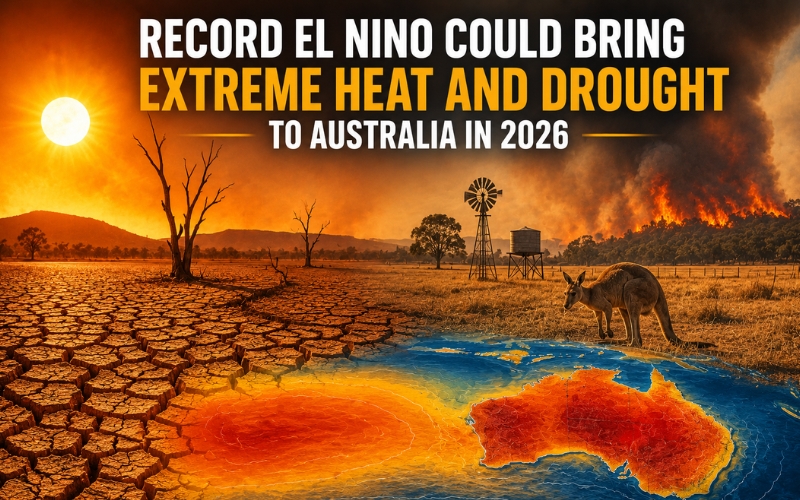
A record El Nino Australia event is intensifying in the Pacific Ocean, with Australia on the brink of experiencing one of its toughest weather seasons in decades. Climate scientists say it’s happening at a faster rate than past El Nino, and that it could lead to higher temperatures, less rainfall and an elevated bushfire risk in the second half of 2026.
Communities around the world, in Europe and North America, have already experienced extreme heat waves and devastating wildfires, and Australia is now anticipating a hot spring followed by another hot summer. This is according to forecasts made by the Bureau of Meteorology (BoM) on several climatic indicators indicating unusual warm and dry weather.
What is El Nino and why is it important?
When parts of Pacific Ocean (central and eastern) become warmer than normal, El Nino effect comes into effect. This in turn affects natural climate and weather all around the world. The warming effects thousands of kilometers of the Ocean, and hence drastic climate changes are seen around the globe.
El Nino is associated with lower than normal rainfall, higher temperatures and an increased risk of drought for Australia. There is the potential for these conditions to continue for several months, impacting agriculture, water resources, ecosystems and bushfire preparedness.
Experts say, this is a record for El Nino, and here’s why
The ocean temperature is monitored closely by meteorologists based on one of the most significant indexes for the strength of El Nino, the Nino 3.4 index.
This index has been surging quickly this year, 2026, and is rarely seen at this stage of the development cycle. Climate models indicate ocean temperatures could continue to increase throughout spring and peak later in the year.
The speed of the ocean warming in the Pacific Ocean is important since the more heat the ocean releases into the atmosphere, the greater the risk for widespread extreme heat that may be experienced in Australia in the next couple of months.
These factors, coupled with the effects of climate change, also could drive regional and global temperatures further into the red.
Extremely hot conditions are likely to occur in Australia this spring
The largest worry is Australia’s upcoming spring season. The Bureau of Meteorology forecast above-normal temperatures for much of the country, with above record- breaking temperatures forecast across southern and eastern areas.
The rainfall forecasts are also worrisome.
El Nino Australia is characterized by a reduction in moisture moving across the Pacific Ocean through the moisture-bringing trade winds. This will lead to reduced rainfall in many areas of eastern Australia during late winter and spring.
The potential formation of a positive Indian Ocean Dipole (IOD), another climate influence which can also lead to a reduction in rainfall over southern and central Australia, adds to the challenge.
Dry conditions often are more widespread when both climate systems are present.
El Nino’s Impact on Global Weather
Pacific oceans warmer water affects the weather patterns all over the globe. This leads to heat waves droughts, heavy rainfall and altered storms.
Over the past few months these effects have been seen around North America and areas of Europe. They are facing high temperature and devastation by wildfire. This because the extra amount of heat retained by the planet is being stored inside pacific ocean, which in turn wreaking havoc globally.
The months ahead for Australians to expect
The overall weather picture is a familiar one, but with a sense of uncertainty.
In most climate models, it is predicted that:
Hotter-than-average temperatures
Above-average temperatures will be buoyant for much of Australia during spring and summer.
Lower rainfall
The amount of rainfall is expected to be below normal over many parts of the eastern region, adding to the strain on water supplies and agriculture.
Greater drought concerns
Farming communities can be impacted by farming activities that use up water, as can soil moisture and natural ecosystems.
Elevated bushfire potential
Dry vegetation and higher temperatures mean bushfire activity is likely to be greater, especially towards the end of the year.
This is year is Likely to be the hottest, Bee crisis is imminent
There is no way to minimize the effects of El Nino, if the people are warned, they can prepare for it. For summer season, locals should make plans ahead of time for emergencies. They should listen to official weather forecast on daily basis and follow the local fire restrictions.
And as dry conditions develop, good water management strategies should be adopted by farmers and non farmers a like.