
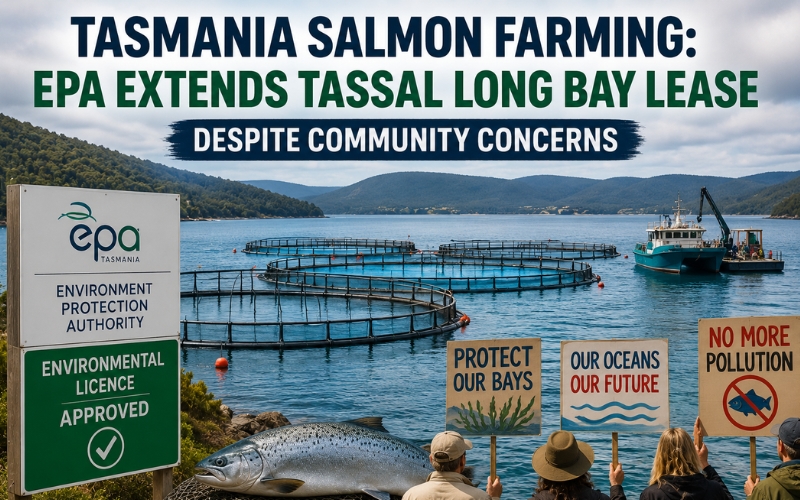
Tasmania Salmon Farming is once again in the spotlight after the Environment Protection Authority (EPA) approved a two-year extension for Tassal’s Long Bay salmon farm near Port Arthur. The decision has reignited debate about balancing aquaculture growth with environmental protection in Tasmania’s sensitive marine ecosystems.
The EPA has determined that current evidence does not indicate that the water quality in Long Bay is being significantly adversely affected by the farm but environmental groups and the community question whether there are areas that still have to be answered regarding the life-long effects of the farm on Long Bay salmon farming. Extension focuses on a key issue for the management of Tasmania salmon farming: environmental sustainability. That is why EPA environmental license of salmon farming is extended.
Why the Tasmania Salmon Farming Lease Extension Matters
The controversy surrounding the Long Bay lease has now been in the news for a number of years due to the lease’s proximity to a shallow coastal environment that is also very sensitive.
In 2017, Tassal long bay again started farming at this site. Since then, EPA asked the company to decrease its fish feed inputs by approximately 20 percent in 2023 by establishing a nitrogen output limit. This measure was put in place to keep nutrients out of the surrounding waters and to limit any possible impacts.
Following further monitoring data, EPA issued the renewed environmental licence for a further two years on the conditions that the monitoring data must be continued.
What were EPA’s conclusions?
The EPA’s evaluation found nutrients from the salmon farm were detected in the area but did not result in an overall degradation of water quality.
Water Quality Monitoring
Ammonia and nitrogen were higher during summer as monitored near the salmon pens. But, these levels decreased after the seasonal removal of fish from the pens indicating that the nutrient concentrations were sporadic and not continuous.
Algae Growth
The growth of algae in Long Bay has been one of the largest community concerns.
EPA reports that the algae concentration did not grow significantly from 2021 to 2025 near the farm. The regulator also found that higher shallow-water temperatures are probably the biggest contributor to algae growth, in addition to farming salmon.
Community and environmental groups continue to be concerned
However, EPA’s decision has not convinced many local people and environmental groups, who are calling for greater caution.
Over 80 submissions came in against the extension of the lease, and there were primarily concerns about nutrient pollution, sea grass decline and scanty environmental baseline information prior to the start of farming.
Because lengthy comprehensive environmental investigations were not performed prior to operations, it is difficult to make accurate measurements of long-term ecological change, according to critics. They have also wondered if the monitoring sites accurately reflect conditions across the entire bay.
There are several groups that feel that a precautionary approach will afford greater protection for one of Tasmania’s unique coastal environments.
Tassal is supporting the decision
The EPA’s assessment was one of the most comprehensive environmental reviews conducted by the Tasmanian aquaculture industry, and was welcomed by Tassal.
The move gives the company’s staff, operations and the wider Tasman Peninsula community certainty, the company said.
Tassal long bay has been issued with environmental notices for its operations in a number of facilities in Tasmania, but EPA took into account the company’s compliance record before approving the extension.
Future decisions will be made based on Continued Monitoring
Instead, EPA will not consider the extension as the end of the line but will continue to monitor the environment.
Future research will focus on:
- Changes in water quality
- Nutrient concentrations
- Sea grass health
- Reef ecosystems
The regulator says more scientific data will assist them in deciding whether the current management is adequate or that other changes are needed.
World’s first in regards to aquaculture and environmental protection
Tasmanian salmon farming is an important economic contributor to the region and employment, and provides seafood production. Meanwhile, the industry is using part of the environment that is very sensitive to marine life that needs to be managed. Meanwhile, the industry uses part of the environment where marine life is sensitive and needs to be managed. That is why EPA environmental license of salmon farming is extended.
The Long Bay salmon farm case is a prime example of the continuing dilemma of economic development vs. environmental protection. Policy makers must continue to assess the sustainability of marine farming, and scientific monitoring, transparent regulations, and community engagement will all continue to play crucial roles.