
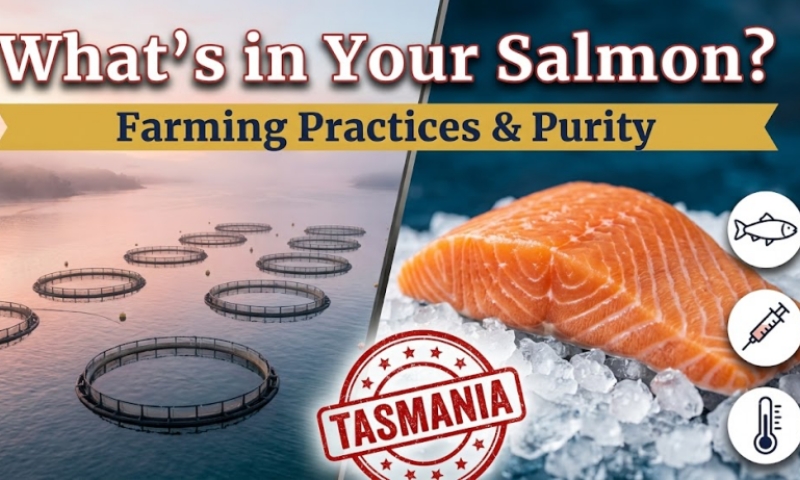
One fish at a time. That’s how Tassal is now treating its salmon in southern Tasmania.
Each fish is caught, put under anaesthetic, injected with an antibiotic, checked over and then returned to its pen. It’s slow, fiddly work, and it’s never been done at sea in Tasmania before.
The company says it has little choice. The bug is back. Summer’s on the way. And the drug it used last time is off the table for now.
The disease is back
The problem is a bacterium called Piscirickettsia salmonis. Last summer it killed salmon in huge numbers.
This time it has turned up in the D’Entrecasteaux Channel, including Tassal’s farm at Great Taylors Bay. By the ABC’s count, about 9,000 tonnes of farmed fish have died in the state so far this year.
Tassal says it’s caught this one early and wants to jump on it. “Treating early, while fish are healthy enough to handle, protects their welfare and limits the spread of disease,” the company said.
Why not the usual drug?
Last time round, farmers put florfenicol in the feed. The industry used more than five tonnes of it between January and March.
But in March, the national regulator, the APVMA, pulled the permit. It found an “unacceptable risk of residue exposure to non-target species”. In plain terms, the drug was getting into other marine life.
That had real knock-on effects. Rock lobster and abalone divers near the farms were shut out of their own fishing grounds last summer over it.
Farmers want florfenicol back. The APVMA hasn’t made up its mind yet. In the meantime Tassal has switched to oxytetracycline, or OTC, which is injected straight into each fish. Just the first pen should need around 10kg.
“Florfenicol in feed is the most effective option, and while we await a permit for it, we’re using OTC where required,” Tassal said.
The company argues injection is more targeted. Every fish gets its own shot, so far less of the drug ends up in the water than with medicated feed.
That matters, because OTC in feed has caused problems before. During an outbreak in February 2025, Huon Aquaculture fed 1,133 kilograms of it to fish at its Zuidpool lease near Bruny Island. An EPA report later found residues in wild blue mackerel nearby of up to 2.4 milligrams per kilogram. Salmon on a supermarket shelf is only allowed 0.2. So that’s roughly 12 times over.
Tasmania’s Director of Public Health, Mark Veitch, said at the time that eating normal amounts of those wild fish was not a public health concern. Plenty of people who fish down there weren’t so relaxed about it.
The industry is bracing for heat
Warm water is the real worry. A marine heatwave is tipped for this summer. Salmon don’t cope well in warm water, and bugs like this thrive in it.
Salmon Tasmania’s chief executive said the industry was “doing everything we can to ensure the welfare of our animals over summer is maintained”. Fish are also being bred and vaccinated to cope better with the heat.
The Greens aren’t buying it
Greens MP Vica Bayley reckons antibiotics only treat the symptom.
“To simply be treating diseased fish with antibiotics isn’t a solution for the environment, [and] it’s not really a solution for consumers,” he said.
Fishers in the channel have their own worry. If florfenicol is approved again, the same wild fishery closures could come back. The industry itself expects that.
It’s a pattern people in the channel know well. Each summer brings the same problems, and each fix seems to land on someone else, whether that’s lobster fishers, locals or the people buying the fish.
What it means if you buy salmon
Tasmanian salmon is a regular on a lot of dinner plates, so it’s fair to ask what this means at the supermarket.
Nobody has said much yet about residue testing on the injected fish, or how long before they can be sold. If that bothers you, ask where your salmon comes from, and watch for updates from the EPA.
Where to from here
No decision on florfenicol yet. So expect more pens to get the needle, particularly once the water heats up.
Tassal, which is Canadian-owned, has already been under pressure from communities over its leases. With a hot summer coming and the disease already spreading, the next few months will show whether this new approach works, or whether Tasmania is in for another rough season on the water.