
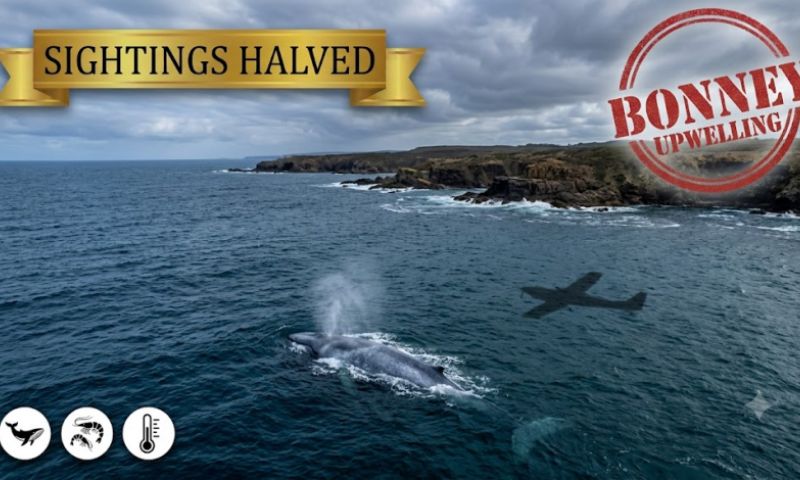
Pete Gill’s spent 28 years flying over the sea off Portland. Counting blue whale sightings, mostly.
More than 300 aerial surveys. One animal he’s looking for. The pygmy blue.
These days he sees about half as many.
Early 2000s, he’d see 12 to 18 whales a flight. On average. Now? Five or six, he told the ABC.
Twelve to 18, now five or six
Dr Gill lined up his flights from 2000 to 2004 against the ones from 2020 to 2024. Sightings were down 51 per cent.
He first noticed something was off in 2012.
Are there actually fewer whales out there? Or have they just changed their route? He doesn’t know yet. Could be either.
The krill is a worry, though. Surface swarms are down about 65 per cent since the early 2000s, by his count. Krill is what the whales come here to eat.
Less krill up top means more work. The whales have to dive 200 metres or deeper to find a feed. That burns a lot of energy.
They might be quieter, too. Big patch of krill about? They call. Deep calls, to bring the others in.
Food scattered all over? Dr Gill reckons they mostly stay quiet then.
“We have to assume that there’s something going on with climate change,” Dr Gill said.
It doesn’t stop at whales, either. Anything else that eats krill loses out too, he said.
Why do they come to Portland at all?
The pygmy blue whale is endangered. Each summer they head along the coast between Cape Otway in Victoria and Robe in South Australia. They’re there to feed.
The reason is the Bonney Upwelling. It’s a strong current near the Victoria-SA border. It drags cold, nutrient-rich water up to the surface.
Krill love it. So do seals, seabirds and fish, from about November through to May.
Local fishing leans on it. Tourism too.
Is a stronger current better?
Not necessarily.
Alex Shute’s been through the lot. Thirty years of upwelling data. He’s a marine ecologist doing his PhD at Deakin University.
It was pretty steady until 2020, he found. The last five years? All over the place. Some years fairly weak. Others “really quite extreme”, in his words.
Climate change might be behind that.
“With climate change, it is generally expected you would have a stronger upwelling,” he said.
In 2024 the upwelling was the strongest on record. You’d think that meant more food. It didn’t. More current didn’t bring more nutrients. Or more krill.
His theory? An extreme year might tip the temperature, he reckons. Past what some of the zooplankton can cope with. Then the whole food chain cops it.
“It’s all about balance,” he said.
Skinny seals too
Fur seals eat out of the same water. Back in August the ABC found they were malnourished. Numbers dropping too.
Portland’s had a rough year for marine news. Portland’s beloved elephant seal Sammy ended up the face of the bird flu scare.
Ask the mayor
Karen Stephens is the Glenelg Shire mayor. She reckons it’s the main thing driving tourism in Portland.
Tuna fishing needs it as well. Big for the local economy, she said.
“It’s really important to us that we do protect the environment,” she said.
There’s even a festival for it. The Upwelling Festival kicks off in Portland this weekend. Parade, market stalls, live music. A few marine science talks.
“The Upwelling Festival is all about our whales,” the mayor said.
It also marks the start of the season. Seven months of cold water, November to May.