
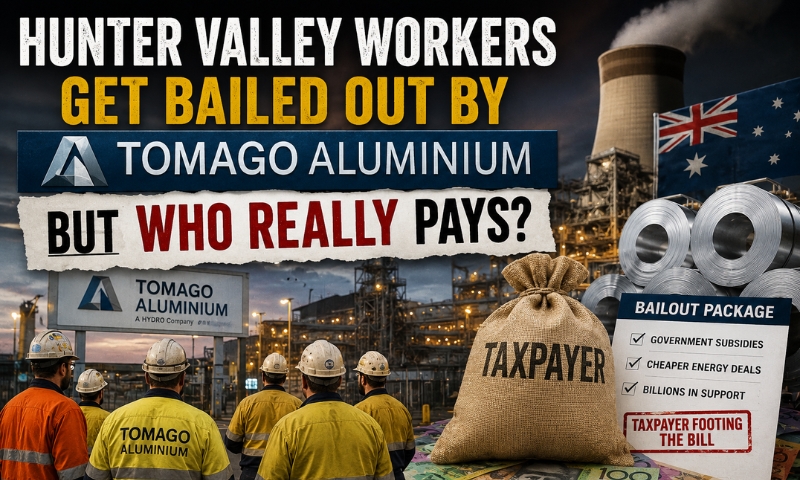
This week a multi-billion dollar rescue package for Tomago Aluminum was provided, but many say it was paid by taxpayer money. It’s being considered a good investment for jobs in manufacturing and others saying it create an undesirable precedent for the extent of public money that should be used to support private business. The crux of the controversy is a single smelter in the NSW Hunter region that until recently seemed set to close its doors forever.
The plant had warned late last year that it would be forced to close once its existing power contract expired in 2028, citing the soaring cost of coal-fired electricity and a shortage of dependable renewable energy capacity capable of running its operations around the clock. That warning set off months of negotiation between Tomago Aluminum’s owners and both the NSW state government and Canberra, culminating in an agreement that keeps the operation running for at least another decade.
This is what this deal entails
In the deal, the mining company that owns the smelter will invest more than a billion dollars, including $240 million that was set aside to reduce the carbon footprint of the smelter, and the state and federal governments will provide taxpayer-backed subsidies to help defray the costs of cheaper energy for the smelter, with the two levels combined covering half of the cost. The combination of the two packages are intended to purchase time for the plant to shift to the use of renewable energy sources without being overwhelmed by short-term cost pressures.
The agreement, for the approximately one thousand workers at the smelter and hundreds of trades workers who participate in the longer-running apprenticeship program, is a real measure of job security. The Electricians, fitters and boilermakers who worried about the future now have a better path forward, and industry leaders say the industry would have lost a decade of years of skilled manufacturing workers that would have been like a meteor smashing through a telescope.
Until now, it has been one of the biggest single bets in Australian industrial policy in recent times, and a gamble that the Government can afford the high price tag on keeping a major plant on line – and a heavy burden on the energy budget – if they can keep it heading towards renewable energy. It will be up to history to decide whether it was a savvy way of supporting the industry or a costly Band Aid measure.
The Price Tag Sparks Debate
Not everyone is convinced the taxpayer arithmetic stacks up. The federal opposition has seized on the rescue as proof that current renewable energy policy has fallen short, arguing that such a large subsidy amounts to an admission that clean power alone isn’t yet reliable or affordable enough to sustain heavy industry. Critics on the other side of politics have raised a different objection, questioning why taxpayer money should flow to a company that posted a profit in the billions just last year, without the public receiving any ownership stake in return.
Energy analysts have offered a more measured take. The long-term prospects for the smelter to use renewable energy are clear, though the viability of the aluminium industry on the 10-year time frame is still uncertain. The same taxpayer-funded scheme may be subject to fresh challenges long before the end of the decade if the demand for or price of these goods changes in an unfavourable way.
What It Means for the Grid
Beyond the immediate jobs question, the agreement carries broader implications for the state’s energy mix. When complete, the agreement will generate a number of GW of renewable energy that will benefit customers beyond the plant. All the households and businesses powered by NSW grid will be benefitted Officials in favour of the package say the “flow-on” supports the public support, as it’s not just one company that’s being propped up, but the state’s broader push toward cleaner energy.
Whether that argument satisfies critic’s remains to be seen, Advocacy groups have called for the government to take a formal equity stake in Tomago Aluminum’s operations, arguing that if public money is underwriting a private company’s electricity bills for a decade, taxpayers should share in any upside if the smelter remains profitable. Others counter that the jobs, apprenticeships and downstream manufacturing capacity secured by the deal already deliver value that a share certificate wouldn’t necessarily improve on.