
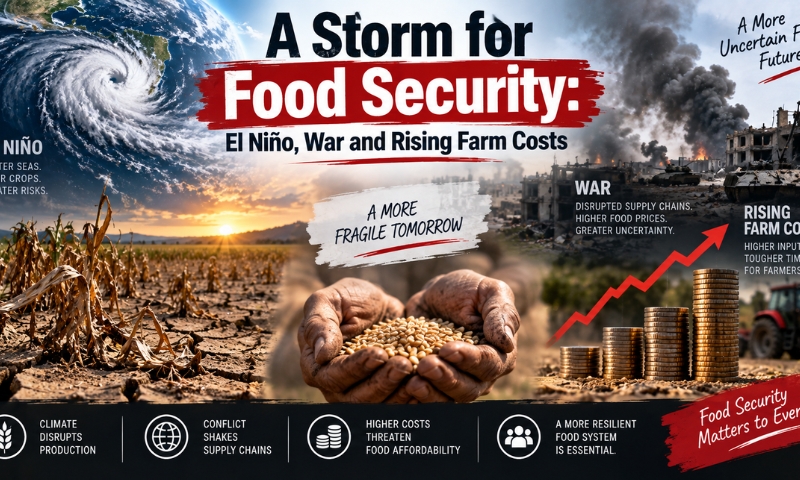
El Niño is poised to wreak havoc on growing seasons, Middle East tensions have made energy and fertilizer availability more difficult and Australia is experiencing a drier forecast as growers make key planting decisions. The global food system could be facing another significant food price shock. Climate pressures, conflict and high energy prices are inducing new stresses on agriculture and international food systems. It’s not just one thing that makes it dangerous. Instead, a bunch of problems is happening all at once.
The result for richer countries might at first be increased supermarket prices. The effects are likely to be even more dire, though, for poorer countries which rely significantly on imports.
Added Uncertainty with El Niño
Due El Nino in the pacific, more erratic weather patterns are on the horizon. More drier and hotter conditions are bound to return and affect farming activities. Growers in Australia are already keenly monitoring the potential of a strong El Niño. Dry weather may lead to low soil moisture, lower crop production, and deter farmers from increasing crop planting programmes.
It is not only a country-issue. El Niño has the potential to impact rainfall in Asia, Africa and the Americas, putting crops from wheat and rice to corn and other staples under stress.
Bad timing is no good. Already, global markets for grain are suffering from disrupted trade routes and increased production costs. Multiple food production areas experiencing droughts at the same time would leave little space for a supply shock to be absorbed.
Why the Middle East Crisis Reaches the Farm Gate
Modern agriculture depends upon global supply chain. That is why its relevant to say that a war happening thousands of kilometers away in Middle East is affecting WA agricultural activities this much. Products like fertilizers, oil & diesel etc move through Strait of Hormuz, which have been severely affected due to war.
For farmers, fuel is not simply a transport expense. Tractors, harvesters, irrigation equipment and freight networks all depend on energy. When the price of refined fuel rises, the cost of producing food rises with it.
The problem is compounded by fertilizer. Modern grain production relies heavily on nutrients such as urea, and disruptions to international supplies can quickly increase costs. Australia has also had to seek alternative fertilizer sources after trade disruptions linked to the conflict.
Australian Farmers Face a Difficult Season
For Australian farmers, the challenge is not simply producing crops during difficult weather. It is deciding how much financial risk to take before the season is even guaranteed. Increased diesels cost, machine operating and fertilizer costs can have a significant impact on margins. While many Australian farmers are familiar with coping with difficult times, adaptation does not reduce financial pressures.
With a long dry season, yields may be affected and with high inputs, the cost of every hectare planted may be high. According to the most recent outlook on agriculture, the seasonality is the overriding determinant of production decisions. The rising price of fuels and fertilizers is increasing the uncertainty, especially in the dry cropping areas. For Australia, this matters beyond the farm sector. The country is a significant exporter of wheat and other agricultural commodities. A weaker harvest can tighten supplies available to international markets.
Refined Fuel Prices Could Push Food Costs Higher
- Energy prices are often the hidden force behind food inflation. A loaf of bread may appear disconnected from global oil markets, but the entire supply chain depends on energy.
- Farm machinery consumes diesel. Grain must be transported to storage facilities and ports. Fertilizer has to be manufactured and shipped. Food products are eventually moved through warehouses and supermarkets.
- That is why shortages of refined fuel can create consequences well beyond petrol stations. Recent pressure on refinery capacity in both Russia and the Middle East has kept global fuel markets vulnerable.
- A sustained increase in the cost of refined fuel could eventually flow through to food prices, although the effect is rarely immediate.
Australia Is Better Positioned, but Not Immune
Despite the risks, Australia remains better positioned than many food-importing nations. It produces substantial quantities of staple foods and has a strong agricultural export sector.
Despite better positioning, Australia is not completely immune from the upheavals of the global market. Extreme weather conditions, rising costs of oil, diesel and other agricultural products will lead to future inflation.