
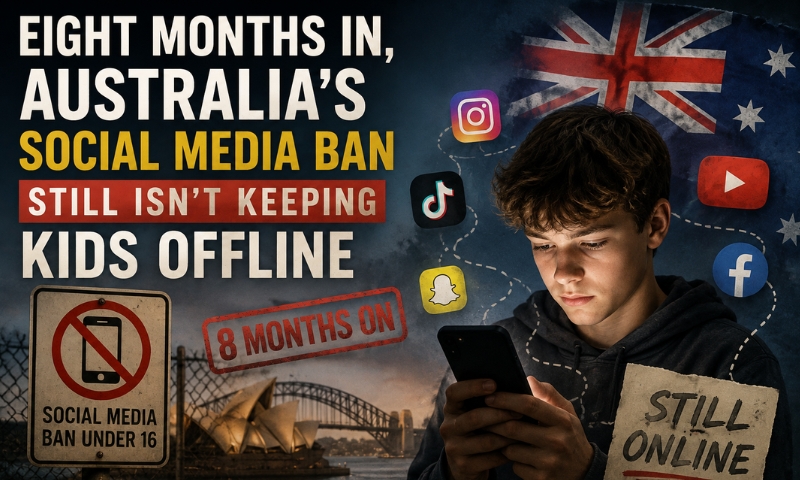
Australia’s social media ban set out to do something no other country had tried: keep children under 16 off the platforms entirely. Nearly a year on, the early evidence suggests kids in Australia barely noticed.
The world watched closely when the country’s social media ban took effect last December. Governments from the UK to parts of Europe were reportedly weighing similar moves, hoping Australia’s experiment would give them a template. Instead, the numbers coming out of the country’s own regulator paint a much messier picture than the headline promise ever suggested.
What the Data Actually Shows
The evaluation reports submitted by Julie Inman Grant (eSafety Commissioner) show a clear picture of the after effects of the law. There were almost little to no change in Social Media usage, over half of the surveyed kids were still logging in after the law was implemented. More than 8 out 10 Australian kids were still using Social Media, even three months after restriction kicked in.
Account ownership did fall more noticeably, dropping from roughly half of surveyed children to around four in ten. But owning fewer accounts isn’t the same as staying off the apps. More than half of children reported never being asked to prove their age at all, and a chunk of those who were checked simply told the platform they were older than they actually were.
This is where Australia’s approach runs into a design problem more than an enforcement one. The legislation never actually required social media companies to lock kids out entirely — it asked them to take “reasonable steps,” while explicitly banning platforms from relying solely on ID checks. Companies had to offer softer, less accurate verification methods as an alternative. In simple words, the failure was expected because the law written poorly from the start.
Who’s Really Being Held Accountable?
Frustration has understandably landed on the big platforms. Investigations are now underway into five services, including Meta’s Facebook and Instagram, Snapchat, TikTok and YouTube, over concerns they haven’t done enough to keep underage users out. The government has responded by moving to double the maximum penalties social media companies can face and expand the regulator’s power to demand information from them.
There’s plenty of reason to distrust these social media companies on youth safety. Court findings in the United States have described platforms like Meta as a public nuisance contributing to psychological harm among young users, and internal research reportedly buried by the company pointed to real damage from its products on teen mental health. Few would argue these firms have earned the benefit of the doubt.
But that’s precisely what makes the social media ban’s structure so puzzling. Having accused these companies of behaving like predators, the government then handed them significant latitude over how enforcement would actually work, without demanding the strictest verification tools available. It’s a bit like asking the shark to help design the net meant to keep it out.
The Regulator Saw This Coming
The Australian Human Rights Commission flagged many problem related to this ban. Back in November 2024 when the law passed, AHRC stated that workarounds such bans are found almost immediately. Hence they will blunt the effects of this law in totality.
Youth advocacy groups predicted that restricted users would simply migrate elsewhere. Academics cautioned that kids would find quieter, more private ways to keep using these platforms rather than stop altogether.
Perhaps most notably, one of the more prescient warnings came from the eSafety Commissioner’s own office, which submitted at the time that age restrictions were already proving easy to sidestep in practice, and that bans alone wouldn’t teach young people safer online habits. That’s the same regulator now tasked with making the policy work.
Is It Too Early to Judge?
Supporters of the policy have a fair point: eight months is a short window for a world-first social media ban to prove itself. Child safety advocates giving evidence to a recent parliamentary inquiry argued it could take three to five years before the ban’s real effects become clear. The eSafety Commissioner has also noted a rise in messaging and gaming activity among young users, exclusions carved out of the original law that may be quietly absorbing some of the time kids would otherwise spend on banned platforms.
Concern for teenagers’ wellbeing online is exactly why this policy earned bipartisan-adjacent public support across Australia in the first place. But that same concern is also reason enough to ask hard questions about a policy that, eight months in, has yet to show the results it promised.