
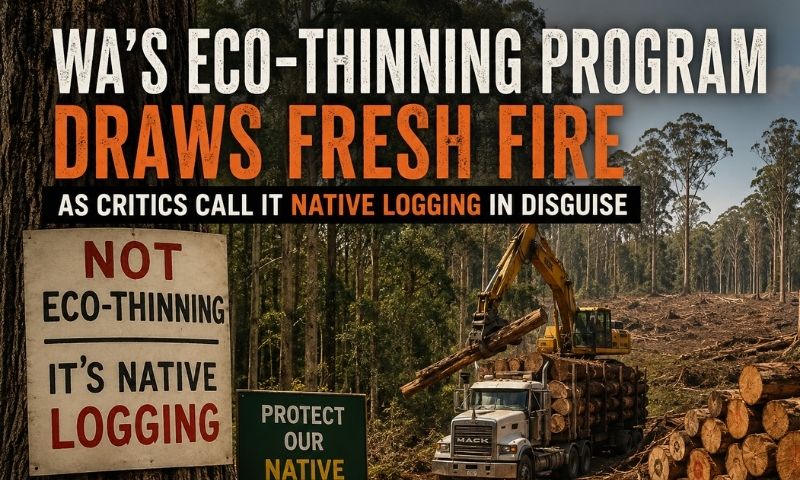
Drive through the karri and jarrah country south of Perth (WA) and logging trucks still rumble along the highways. Years after Western Australia officially ended commercial native logging. What’s changed is the label on the paperwork. The trees now being taken are part of an ecological thinning program, and a growing number of locals, scientists and conservation groups are asking whether the practice is anything more than the old industry wearing a new name.
A Trial Born from a Drying Climate
The scientific case for thinning rests on water stress. Forests of karri, jarrah and marri-forests in re growth form-are beginning to vie for a diminished water supply and some are becoming stressed or even dying out as the water supply becomes scarcer in the warmer, drier environment of the South West of WA.
Since native forest logging was formally phased out in 2024, roughly 3,000 hectares have been ecologically thinned; a small fraction of the state’s forest estate but a figure conservationists say is climbing fast. The WA Forest Alliance has pointed to a WA government program with an eventual budget in the tens of millions of dollars and an annual thinning target of up to 8,000 hectares, an area larger than the yearly footprint of native logging in its final years.
Landowners See Familiar Machinery, Familiar Results
For residents near Pemberton, the distinction between thinning and logging has proven hard to see on the ground. Retired teacher Jeff Thornton, who has watched contractors working near his property for the past year and a half, describes the operation bluntly as native logging by euphemism, arguing the work looks and sounds identical to what preceded the ban. He points to thinned sites where large stumps remain but few big trees are left standing, and worries the wildlife dependent on that habitat is already paying the price. Black cockatoos that nested on his block every year, he says, failed to return this season.
Drone footage circulated by conservation groups has shown sizeable stockpiles of timber near Manjimup in Western Australia’s South West, fuelling suspicion that FPC operations are producing far more commercial log volume than the ecological rationale would suggest. Contractors carrying out the work, notably, are largely the same companies that once operated under native logging licenses.
Who Actually Runs the Program?
Oversight of the thinning trial sits with the Forest Products Commission, the WA government agency responsible for both plantation forestry and native forest operations. The Forest Products Commission negotiates supply contracts site by site, and there is no single, consistent maximum tree diameter written into those agreements, meaning thinning intensity can vary considerably from one FPC coupe to the next. Silviculturists trained in forest growth patterns are tasked with marking which trees survive and which don’t, with the FPC’s field contractors carrying out the actual removal.
The Department of Biodiversity, Conservation and Attractions says it conducts independent inspections of FPC-managed sites, and both agencies maintain the process is fundamentally different from native logging because only smaller trees are targeted. Agriculture Minister Jackie Jarvis, who holds WA government portfolio responsibility for the FPC, declined to be interviewed on the program’s design or its critics’ concerns.
Scientists Split Over the Evidence
Australian National University conservation biologist David Lindenmayer, who has studied forest thinning around the world, is sceptical about the science behind intervening at this large a scale, noting that ecosystems have not been altered by humans for hundreds of millions of years. He says that as the trees are thinned the forest floor may be left with more debris, drying conditions may be worse and fire risks may be higher, instead of lower, due to thinning; and that it is inaccurate to believe the thinning can make up for decades of dense re growth that occurred as a result of earlier thinning.
Early monitoring of the current FPC program, Dr Ruthrof says, is showing similarly encouraging signs of reduced water stress.
A Program Still Being Judged
The program will be reviewed for the next two years, for its effectiveness” says environment minister Matthew Swinbourn. He further defended the idea by pointing
- Thinning will improve ground water recharge and stream flow.
- It makes the forest more resilient towards draught and fire.
For now, the fight over what to call the practice, thinning or logging by another name, shows no sign of settling. What both sides agree on is that Western Australia’s forests are under genuine stress, and that decisions made in state government offices over the next few years will shape whether the South West’s karri and jarrah country recovers or continues to decline.