
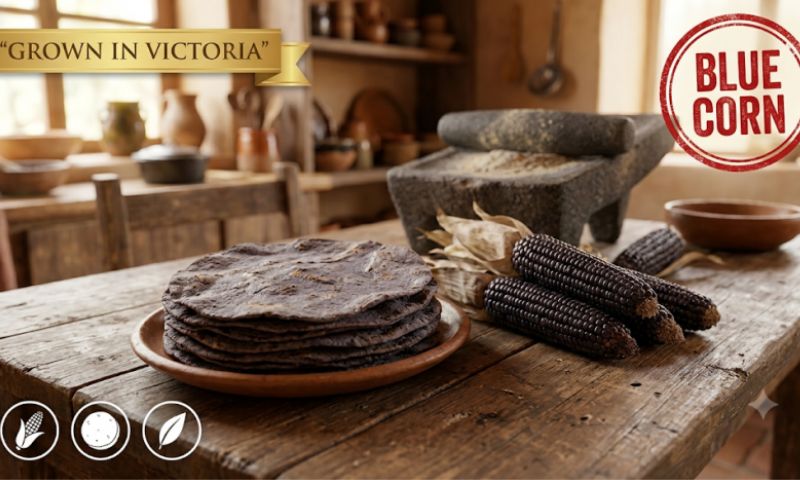
A stack of deep blue-purple corn tortillas next to blue corn cobs on a rustic wooden table
A woman on a Mexican street corner. That’s what Gerardo Lopez remembers. She made blue corn quesadillas. By hand.
He’d eat them after a weekend up the mountains, climbing. A reward, he called it.
That same blue corn is now growing in Victoria. Commercially. A first for Australia, the ABC reports.
From Everest to Kensington
Lopez grew up in Mexico City. Engineering degree. A master’s in London. A job in Los Angeles.
Then he climbed Mount Everest in 2009. Somewhere on the way down, he decided on Australia. He landed in Melbourne that same year, Onya Magazine reported.
In 2013 he co-founded La Tortilleria with Diana Hull. She’s an anthropologist who’d studied in Mexico. It’s a Mexican food company, based in Melbourne.
The restaurant’s in Kensington. Stubbs Street, among the warehouses.
“You can’t have good Mexican without good tortillas,” Lopez told Onya.
The business grew fast. About 50 staff by 2019. Its tortillas picked up a Delicious Produce Award in 2016. Corn chips? Gold at the Australian Food Awards, 2019.
Restaurants, cafes and shops across the country stock them. Some go to Singapore and Hong Kong too.
Six years. About 10 seeds.
Six years of R&D. That’s how long getting blue corn here took.
Australia’s quarantine and biosecurity rules are strict. They had to work through all of it.
“You start from nothing really,” Lopez said.
Ten seeds, roughly. That’s what got planted at the start. They got 20 seeds back on this side.
A CSIRO funding grant helped. So did researchers at Federation University.
Enter the plant breeder
Gururaj Kadkol came on board in 2023. He’s an Australian scientist. Forty years of plant breeding behind him.
The early trial plants? Fairly small yields.
So they kept trying. Eventually they found a variety “that seems to grow happily”, Kadkol said.
The crop harvested this March looked promising.
How much? Maybe six or seven tonnes a hectare, he reckons.
They need to get higher than that. For now, though, it does a reasonable job.
Lopez watched the harvest. Machinery going through. Corn piling up, “tonnes and tonnes and tonnes” of it.
Amazing, he said.
Why is it blue?
Anthocyanins. They’re the pigments behind that deep blue colour.
Same antioxidants you get in blueberries.
Blue corn has the best anthocyanin content, Kadkol reckons. Good health benefits too.
What’s it taste like?
Nutty. Earthy. That’s how Lopez puts it.
He can’t really pinpoint another food with that flavour.
“It not only tastes [like Mexico], it smells like Mexico.”
Corn is gold
Tortillas are the whole point of the business. Their regular ones are made from Australian-grown corn.
The maize gets soaked overnight in lime. Rinsed. Then ground with volcanic Mexican rock. That’s how Australian Food News described it back in 2019.
“Corn is gold, it’s life,” Lopez said then.
How old is it?
Old. Mexicans have grown blue corn for thousands of years.
Lopez feels the weight of that. There’s a whole tradition that comes with the crop, he said.
“We’re responsible to make sure that we continue to honour those traditions and do it the right way.”
What he wanted, really, was the tortillas from the small towns. The villages.
As far as they can tell, nobody else outside Mexico has grown a crop for tortilla-making. That’s Lopez’s claim, anyway.
Health food shelves next?
Nutritional testing comes first. They want to know more about this Australian blue corn.
Then the health food market. Then export.
It could be a good thing for farmers, Lopez reckons. Australians too.
Australian food’s having a moment anyway. Australia’s first Michelin stars landed in South Australia last month.
Kadkol says it takes time to get a new crop used to Australian conditions. Six years, in this case.