
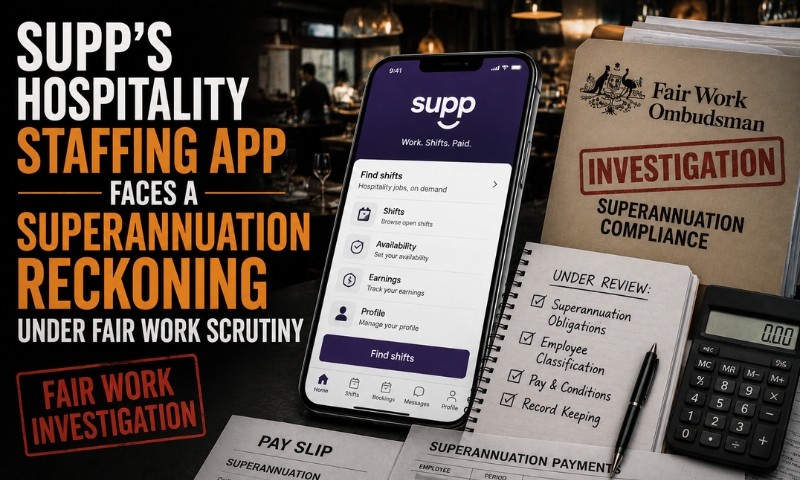
A shift-booking app ‘Supp’, that has been a regular tool in the back room of many cafes and behind the bars of various cities is now up for formal consideration from The Fair Work Ombudsman, following a worker’s complaint questioning how it categorizes users.
Supp is marketing itself as a quick and easily-useable option for hospitality venues to plug their gaps at the last minute. It has since become a kind of digital hotspot, bringing together bars, pubs and cafes with people who want to fill in shifts on the spur of the moment and have become a place where short-term work is possible.
The Fair Work Ombudsman is Taking a Closer Look
An investigation has been confirmed by The Fair Work Ombudsman. They will investigate the platform’s after worker concerns, in which the Supp app is misclassifying workers as independent contractors, instead of employees. The office is still investigating the incident, and in the meantime could not comment any further, but urged anyone with concerns to contact them directly, as there is an anonymous reporting feature – including in languages other than English.
That distinction between employee and contractor status matters enormously, particularly when it comes to superannuation. The platform’s own website tells workers they’re responsible for handling their own tax and superannuation obligations, treating them as independent contractors from the outset. But employment lawyers say labels alone don’t settle the question.
Fay Calderone, an employment lawyer and partner at Hall and Wilcox, told the ABC that one of the biggest risks in this space is assuming a contractual label is the final word. Simply holding an ABN or being described as an independent contractor, she said, doesn’t automatically determine someone’s actual legal status. What matters more is the substance of the working relationship – how much control is exercised over the worker, whether they can genuinely run an independent business, whether they’re able to delegate the work to someone else, and whether they carry any real commercial risk.
A Familiar Story in the Gig Economy
Sham arrangements, where a business insists workers are something other than employees; have drawn scrutiny across the hospitality gig economy for years, with several companies fighting similar claims through the courts.
The company says it connects more than 15,000 venues with over 200,000 workers across a handful of major cities, including Melbourne and Sydney. One Melbourne hospitality worker who has used the platform for several years, and who asked not to be named because he still relies on it for work, said the nature of his shifts feels a lot more like employment than genuine contracting. He described being told exactly where to stand, what section to cover and whether he’d be on customer service or behind the bar – hardly the hallmarks of running his own business.
Supp’s chief executive also stressed that the platform itself isn’t the employer in any given arrangement. Businesses using the platform, he said, are the ones responsible for meeting their legal obligations toward the people they engage, superannuation included.
The Chief Executive Pushes Back
In a statement, Supp’s chief executive Jordan Murray firmly rejected any suggestion that the platform deliberately misrepresents working relationships or enables sham contracting. He said the platform was built to solve two long-standing headaches in hospitality: venues scrambling to fill gaps through informal, low-transparency channels like Facebook groups, and workers wanting more visibility, choice and access to extra income or ongoing opportunities.
That distinction offers little comfort to Daniel McBurnie, who has used the platform since 2021 and says he’s never received a superannuation payment through any of his Supp shifts. He estimates he’s accumulated close to $20 in unpaid super across various one-off shifts at different venues – a sum too small, in his view, to justify the hassle of chasing individual businesses through a dispute process. He worries a much larger group of workers could be missing out on building genuine retirement savings without realizing it.
Since July 2022, the removal of the monthly minimum income threshold means every employee aged 18 or over is entitled to superannuation contributions regardless of how little they earn in a given period – a change that makes the stakes of misclassification even higher. Supp’s chief executive maintains that responsibility for meeting those obligations sits with venues, not with the platform connecting them to workers.
Crucially, Calderone points out those even genuine independent contractors aren’t automatically excluded from superannuation entitlements. Where a contract is wholly or mainly for someone’s labor, she said, super obligations can still apply – a nuance she believes is widely misunderstood by both hospitality businesses and workers alike, and one that could shape how this case unfolds.