
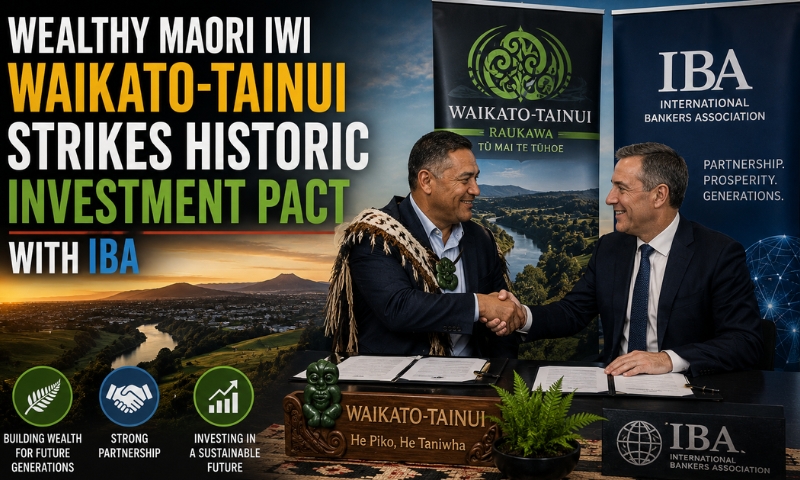
A handshake in Sydney this week could reshape how First Nations groups on both sides of the Tasman do business together. Waikato-Tainui, one of the wealthiest Māori tribal authorities in Aotearoa, has agreed to a new investment partnership with Indigenous Business Australia, known widely as IBA, and the people behind it aren’t shy about calling it historic.
The letter of intent, signed today, gives the iwi a formal pathway into large-scale, Traditional Owner-backed projects spanning mining, agriculture, infrastructure and renewable energy. For an iwi that already manages roughly $2 billion in assets, it’s less a toe in the water than a genuine expansion strategy – one built on the idea that Indigenous nations can fund each other’s growth rather than waiting on outside capital.
Why This Māori Investment Deal Matters Now
Darren Godwell, who chairs the agency, didn’t hold back when describing the significance of the agreement. He called it a seismic moment for Indigenous self-determination, arguing that iwi and local Traditional Owner institutions finally have the financial muscle to back one another at a scale that matters. Rather than small grants or one-off support, this is about mobilizing serious capital so Traditional Owners can take an equity position in the biggest projects happening on their own Country.
Godwell expects demand to be intense once the offer is formally extended more broadly. His logic is straightforward: plenty of Traditional Owner groups have ambition and land-based opportunity but lack a ready source of patient, culturally aligned capital. The iwi, with its scale and appetite for long-term returns, fills that gap.
Tuku Morgan, who chairs the iwi and travelled to Sydney for the signing, he spoke of cohesion, of doing business grounded in common cultural and environmental principles, and of a relationship that goes well beyond a standard commercial contract.
From Retail Back Home to Ports and Mining Offshore
The iwi is no stranger to commercial success, already holding substantial interests in retail, residential property; ports and agriculture back home in New Zealand. But leaning entirely on one domestic economy carries risk, and diversifying offshore is part of a deliberate strategy to spread that exposure. Australia, resource-rich and with a growing appetite for First Nations-led ventures, was the logical next step.
The agency said its role would be to smooth that transition – sharing market intelligence, local knowledge and, crucially, direct relationships with Traditional Owner groups who might welcome a partner like Waikato-Tainui at the table.
No specific projects have been locked in yet, but early contenders are already being floated. One frequently mentioned example is Yindjibarndi Water Co’s move to acquire the Dampier Seawater Desalination Plant in the Pilbara from Rio Tinto and the WA government, a deal Godwell described as exactly the kind of large-scale proposition this partnership was designed for. Mining operators and energy developers across WA are reportedly watching closely to see whether Waikato-Tainui becomes a regular co-investor in projects on Traditional Owner land, particularly given the scale of resource activity already underway across WA.
A Stepping Stone for Indigenous Investment Worldwide
Yindjibarndi Group chief executive Michael Woodley welcomed the announcement as proof that Indigenous peoples can support one another’s growth across international borders; something he noted hasn’t historically been common. He believes the market will read this as a stepping stone – a signal that capital for good ideas doesn’t have to come from conventional lenders. Woodley also hopes it encourages other tribal institutions around the world to follow suit, positioning this partnership as something of a proving ground for global First Nations economic development.
Morgan framed the underlying purpose simply: ensuring lasting prosperity for his people while protecting the environment and keeping Māori culture and language alive. He also pointed to a more personal dimension of the deal. There are more than 100,000 people belonging to Waikato Tainui indigenous group in New Zealand and an estimated number of 15,000 in Australia.
“They are part of our family,” Morgan said. “Connecting and doing this high-level agreement is more than just doing business. This is family.”
The partnership will be formally reaffirmed next month in New Zealand, timed to coincide with the annual celebration marking the Māori Queen’s coronation – an event expected to draw thousands and lend the deal an even more public, ceremonial weight as both sides look to turn intent into action. For now, though, it’s the memory of a quiet signing in Sydney, between IBA and Waikato-Tainui, that both parties hope will be remembered as the moment two Indigenous investment institutions decided to bet on each other.