
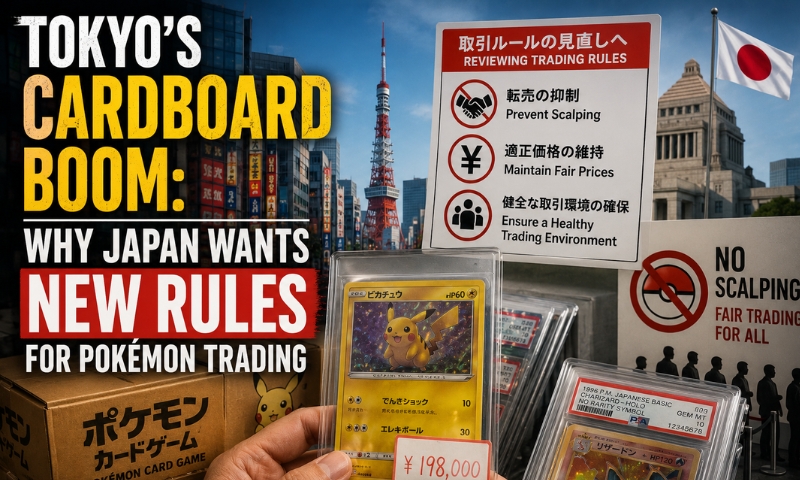
A hobby that used to live in schoolyard binders has turned into one of the strangest asset classes on earth, and Japanese government is starting to notice. Rare Pokémon cards are now changing hands for sums that rival fine art or property, and the country where the franchise was born is weighing whether the market has outgrown its current lack of oversight. Pokémon remains by far the biggest name driving that demand, even as rival franchises watch prices climb too. At the centre of the debate sits a single, uncomfortable question: is anyone using this collectible craze to move dirty money?
Pokémon Prices Have Gone Wild
The prices are stupendously large, a Pikachu illustrator card of 1998 was recently sold at $16 million. It has been estimated that japans domestic trading card market has rose to $2.1 billion till 2025. A mere children’s game has evolved into a real investment venture for locals.
The change has been seen up close by the head of the specialty store Hareruya2, Watanabe Sho, in Tokyo. He says that interest in the last five or six years has been “skyrocketing” to the express extent that a Pikachu card that he recently sold in his shop for approximately $89,000 was a well-preserved early Pikachu card. Watanabe Sho claims the shop now attracts as many visitors from overseas as from Japan and a large number of visitors are searching for Japanese-language prints which are considered to have a certain cachet in foreign countries.
The Money Laundering Worry
That kind of value packed into a small, easily transported object has caught the eye of regulators. Legal experts warn that Pokémon cards, precisely because they’re portable, hard to trace and increasingly liquid, are a tempting vehicle for money laundering. A card worth hundreds of thousands of dollars can cross a border in someone’s pocket, changing hands with none of the paperwork a bank transfer or property sale would require.
Lawyer Fukui Kensaku, who has studied the trading card boom closely, has pointed to a cluster of related problems: counterfeit cards flooding the market, straightforward theft from stores and collectors, and the risk that expensive cards get used for illicit overseas transfers dressed up as ordinary hobby transactions. He’s also flagged “reckless speculation,” warning that some ordinary buyers are risking financial ruin chasing cards they can’t really afford. Fukui isn’t alone in raising the alarm – financial watchdogs elsewhere have flagged similar money laundering pathways in high-value collectibles, but a trading card’s sheer portability makes it a particularly attractive option for anyone looking to move value quietly.
Japanese Government Sets Up a Taskforce
In response, the Japanese government has formed a parliamentary group, led by lawmakers from the ruling party, to examine how trading cards should be treated going forward. The group has already stated plainly that cards “are no longer simply consumer products,” pointing to the market’s rapid growth and the asset-like value certain cards now carry. Officials are looking at authentication standards, fake-detection technology and curbs on bulk buying by scalpers, alongside the money laundering risk that’s drawn the most attention from lawmakers.
Kihara Seiji, who chairs the group, has been careful to frame this as calibration rather than a heavy hand, cautioning that regulation shouldn’t go so far it kills off a market that still brings genuine joy to millions of fans. Japanese government understands that blunt restrictions won’t stop this industry. Resellers and collectors deal globally, not just within the country. Hence, they are keener on cooperation with the people involved in such dealings.
What This Means for Everyday Collectors
None of this changes much for someone opening a fresh booster pack. In the game itself, an expensive card isn’t necessarily a stronger one – the playing field stays level regardless of resale price, as dedicated players are quick to point out.
But the more serious worry that people such as Watanabe Sho have to contend with is that fans are essentially being excluded altogether from this hobby they’ve enjoyed since childhood and made it their entire life. This idea of an ID-based lottery system has already been implemented for some special releases, in an effort to ensure that players who do not bulk buy or utilize bots are not left with nothing.
Whether Tokyo’s new taskforce results in formal legislation or a lighter-touch framework, industry cooperation remains to be seen. But the direction is clear: a market that started with kids trading cards at recess has grown lucrative enough that questions about counterfeiting, scalping and money laundering are now being asked in the halls of government rather than the schoolyard. How Japan chooses to answer those money laundering concerns could end up shaping collectible markets well beyond its own borders.